You're probably staring at marker sets that all promise smooth blends, vibrant color, and “professional quality,” while your cart keeps changing every ten minutes. One minute you're convinced Copic is the only serious choice. The next, an Ohuhu set looks smarter. Then Prismacolor shows up because you like how it lays color down, and suddenly the whole thing feels harder than the actual art.
That confusion is normal. Alcohol markers aren't just a color purchase. They're a workflow purchase. The right brand depends on how you draw, what paper you use, how often you color, and whether you want the cheapest entry point or the most dependable long-term toolset.
Finding Your Perfect Match in a World of Color
The first time most artists shop for the best alcohol marker brands, they compare sets like they're buying colored pencils. That usually leads to the wrong choice. Marker performance is less about how many colors come in the case and more about how the ink behaves in your hand.
If you color manga faces, soft portraits, fashion sketches, or adult coloring pages, you need smooth layering and predictable blending. If you fill larger spaces, render backgrounds, or work fast, nib shape and ink flow start mattering more than the brand logo on the cap. And if your budget is tight, the most affordable set isn't always the least expensive path once dry tips and weak blending start getting in the way.
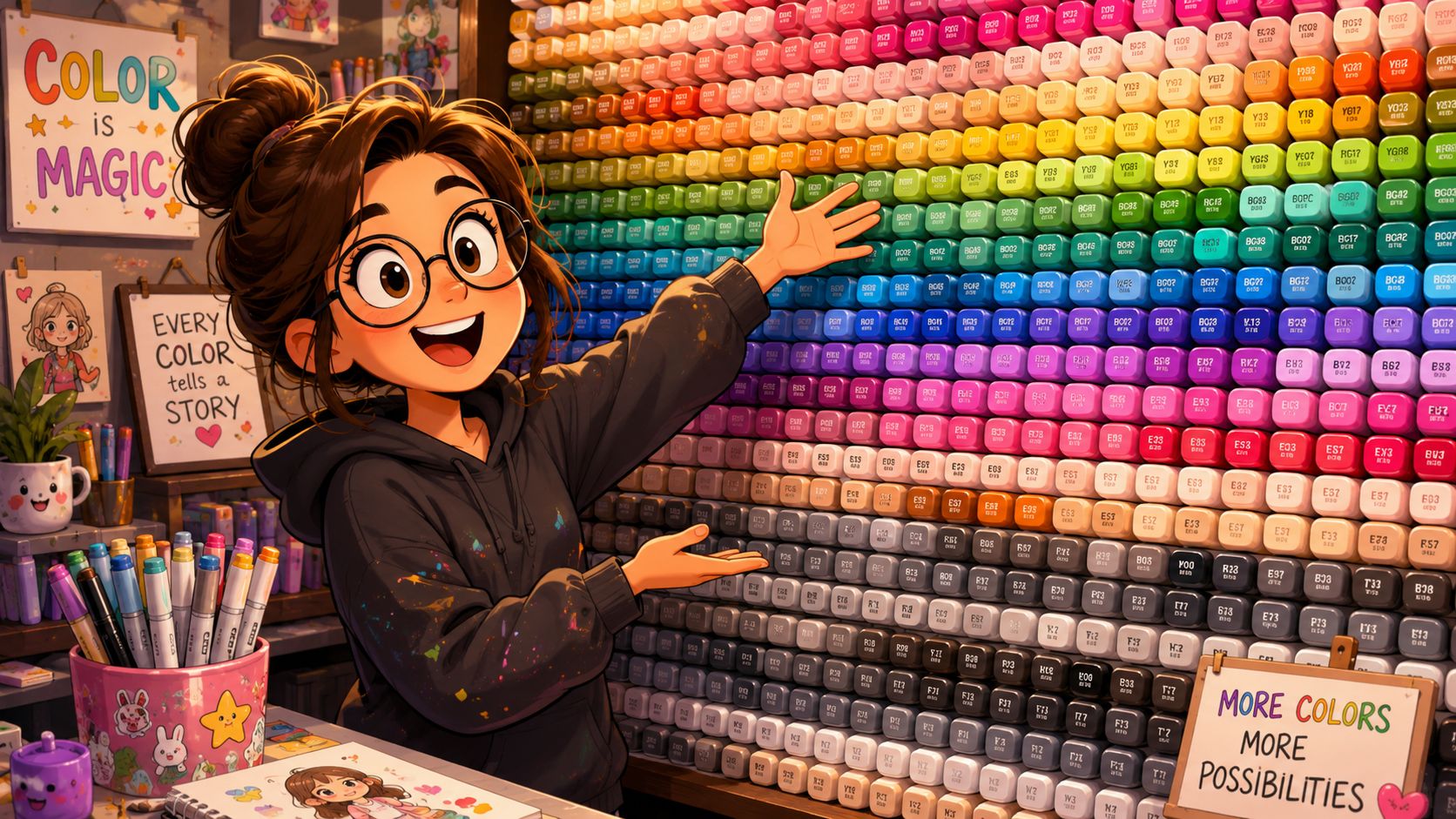
I've seen beginners buy huge sets because the color count feels reassuring, then realize they only use a fraction of the palette and dislike the way the markers handle. I've also seen artists delay buying anything because they think they must commit to the most premium option right away. Neither extreme helps.
A better approach is to match the brand to your actual workflow. Think about your paper, your subjects, your tolerance for replacing markers, and whether you enjoy broad expressive coloring or tight controlled rendering. If you want help planning color families before you buy, a marker-friendly palette generator can make your choices feel a lot less random.
The best marker brand isn't the one with the loudest reputation. It's the one that disappears in use and lets you focus on the drawing.
Understanding Alcohol Marker Anatomy
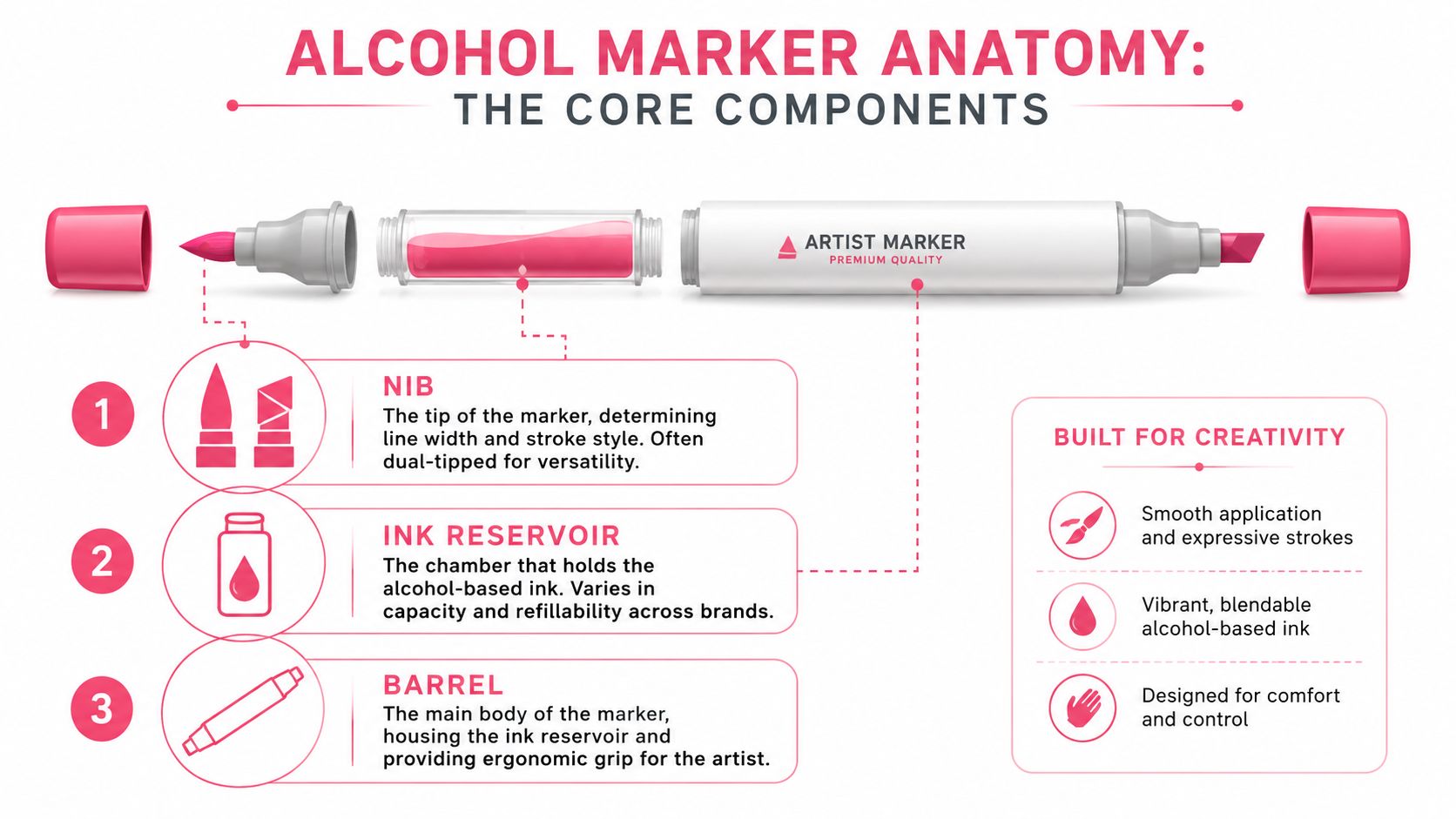
A lot of marker frustration comes from buying without understanding the tool itself. Once you know what affects feel and performance, the differences between brands make much more sense.
Ink and why consistency matters
Alcohol markers use fast-drying ink that's designed to layer and blend before it fully sets. What artists feel as “smooth” usually comes from a mix of ink flow, evaporation speed, and how evenly the dye distributes on the page.
Some brands stay wet just long enough to make gradients easy. Others dry a touch faster, which can still be useful for crisp rendering but makes large blends less forgiving. Refillable markers matter here because long-term consistency becomes part of the value. A marker you can maintain often stays in rotation longer than a cheaper one that becomes scratchy and uneven.
Here's the practical distinction:
- Steady flow: Better for skin, skies, soft shadows, and clean blends.
- Heavier laydown: Good for bold color and saturated fills, but it can band sooner.
- Refill support: Better if you use favorite colors constantly and don't want to replace full markers.
Nibs and how they change your drawing style
Nibs decide how the marker feels far more than many beginners expect. A brush nib gives you variation, softer edges, and better control for expressive coloring. A chisel nib covers space fast and helps with broad gradients. A bullet or fine tip is useful for detail, but it won't replace a good brush if you like organic strokes.
Most artists end up wanting dual-tip markers because switching tools less often keeps the workflow fluid.
Practical rule: If you color characters, florals, or anything with curved forms, prioritize a brush nib. If you mostly fill graphic shapes or backgrounds, chisel performance matters more than people admit.
Barrel shape and hand comfort
The barrel seems minor until you color for an hour. Oval barrels resist rolling and often feel more stable. Round barrels can be comfortable but may shift more on the desk. Some artists like slimmer bodies for detail work, while others want something chunkier that doesn't cramp the grip.
A good marker should feel balanced when capped and uncapped. If a barrel feels awkward, you'll notice it most during repetitive blending passes, not in a quick swatch test.
A simple buying checklist helps:
- Check the nib combo first. That determines your line quality and coloring rhythm.
- Look for refill or replacement support if you color often.
- Pay attention to barrel comfort if you work in long sessions.
- Judge the marker on your paper, not only on swatch cards.
The Top Alcohol Marker Brands Compared Side-by-Side
A side-by-side comparison works best when you judge each brand by the same standards. I look at blending feel, nib behavior, reliability, replacement options, and whether the price makes sense for the kind of work you do.
Quick comparison table
| Brand | Best for | Main strength | Main trade-off | Price feel |
|---|---|---|---|---|
| Copic | Professional illustration, dependable blending | Category benchmark for consistency and refill ecosystem | Expensive upfront | Premium |
| Ohuhu | Budget-conscious artists who still want strong performance | Excellent value and very capable blending | Not quite the same prestige or support ecosystem as Copic | Affordable to mid-range |
| Prismacolor | Rich color laydown and expressive coloring | Pleasant saturation and appealing color character | Less forgiving on some surfaces and workflows | Mid-range |
| Winsor & Newton | Artists who like a traditional art-brand feel | Strong color presence and good artistic handling | Surface sensitivity matters more | Mid to premium |
| Spectrum Noir | Hobby coloring and accessible sets | Easy entry and broad consumer appeal | Less often the first choice for top-tier blending demands | Budget to mid-range |
If you want to compare sets visually while shopping, a dedicated marker comparison tool helps sort what you need instead of just chasing larger boxes.
A video walkthrough can also help if you like seeing marker behavior in motion before deciding.
Copic
Copic is still the benchmark most other alcohol markers get measured against. According to a review citing Copic's long-standing position in the category, the brand invented the technology in 1938, and professional-grade Copic markers are consistently priced between $4 and $8 per unit, while Ohuhu ranges from $4 to $5.85 per marker in that comparison (Copic brand overview and pricing context).
That premium status isn't just branding. In a benchmark of 90+ marker brands, Copic Sketch markers posted a 98% blending success rate on recommended Bristol paper, while premium alternatives like Ohuhu Hartford and Prismacolor Premier averaged 85% to 89% in that test (Sarah Renae Clark blending benchmark). In practice, that shows up as smoother transitions and fewer visible edges when you're layering quickly.
What Copic does well:
- Blending reliability: Copic builds its reputation on this strength.
- Professional feel: The brush response and ink behavior stay predictable.
- Long-term system: Refill and replacement support make the brand easier to build around.
What stops some artists:
- Price pressure: Buying open stock and filling gaps gets expensive fast.
- Not necessary for everyone: If you're coloring casually, Copic can be more tool than you need.
Copic makes the most sense when inconsistency costs you time, not just money.
Ohuhu
Ohuhu is the brand I recommend most often for artists who want serious performance without committing to full Copic pricing. In a controlled spectral analysis, Ohuhu Honolulu and Husman markers reached a 92% color fidelity score against Copic's palette, with a per-color cost of $0.45 versus Copic's $1.85 in that comparison (Nienke Vletter marker brand battle).
That same comparison notes a 1.2 mm to 6.5 mm line width range for Ohuhu's dual-tapered chisel tip, compared with 1.5 mm to 5.0 mm for Copic in that analysis. On the page, that translates to useful flexibility for artists who want detail and broader fills from the same marker.
Ohuhu's strengths are easy to feel:
- Strong value: It's the best step up from bargain markers for most hobbyists.
- Good blending: Not identical to Copic, but much closer than the price gap suggests.
- Generous utility: The sets feel practical, not stripped down.
Its limits are mostly about refinement. The handling can be a little less polished than Copic in edge-case blending situations, especially if you work fast and layer heavily.
Prismacolor
Prismacolor appeals to artists who like rich laydown and a softer, more painterly feel. The colors can feel lush and satisfying, especially in illustration and coloring-book work where saturation matters as much as technical blending.
The downside is that Prismacolor can be less forgiving when your paper and pace aren't well matched to the marker. If you overwork an area, it's easier to run into bleed or texture interference. That doesn't make Prismacolor bad. It means it rewards a slightly more deliberate hand.
Prismacolor is a solid fit if you care about:
- Color personality
- Expressive fills
- Traditional art-supply familiarity
It's a weaker fit if your top priority is the cleanest possible repeated gradient performance.
Winsor & Newton
Winsor & Newton sits in a similar conversation with Prismacolor for many artists. It has the feel of a traditional art brand and tends to appeal to people who already use mixed media supplies from the same ecosystem.
On good paper, the color can look rich and confident. On the wrong surface, the experience can get less predictable. That matters if you like to experiment outside standard marker paper.
I usually recommend Winsor & Newton to artists who want a familiar fine-art brand and enjoy testing surfaces with intention, not to someone who wants the easiest plug-and-play marker system.
Spectrum Noir
Spectrum Noir works well for hobby coloring, casual illustration, and artists who want approachable sets without jumping to premium pricing. It's often easier to justify as a starting point if you aren't yet sure how committed you are to alcohol markers.
Its trade-off is simple. It usually isn't the first brand people mention when they want the absolute best blending performance. But if your goal is enjoyable coloring, broad access, and decent everyday use, it can still be a satisfying choice.
How Markers Perform on Different Paper Types
Some marker reviews act like paper is a footnote. It isn't. Paper can make a great marker feel average, or make an average marker feel much better than expected.
A useful gap in many guides is surface-specific advice. One source points out that artists increasingly use mixed media, watercolor, and Yupo paper, yet many comparisons skip how alcohol markers behave on those surfaces. That same source notes that Prismacolor and Winsor & Newton perform richly on textured watercolor paper but bleed aggressively on uncoated Yupo, while Ohuhu's alum-tip variants offer better control (paper compatibility observations from Syloon).
Bristol and marker paper
If blending is your top priority, smooth Bristol and purpose-made marker paper are still the safest bets. The surface gives the ink room to move without grabbing too much texture, which helps gradients stay cleaner and keeps nib wear lower.
Premium blending differences become easiest to notice. If you're testing the best alcohol marker brands fairly, start on a smooth surface first. Otherwise you may blame the marker for what the paper is doing.
Watercolor paper and mixed media paper
Textured watercolor paper can create beautiful effects, but it changes the rules. The tooth breaks up your strokes, so blends often look more textured and less glassy. That can be gorgeous for sketchbook work, architectural studies, and looser illustrations.
Mixed media paper sits in the middle. Some sheets handle markers nicely, while others absorb too quickly or feather more than expected. I test pale midtones first, because they reveal streaking and drag sooner than dark shades.
If you love visible texture, don't force your marker work to look airbrushed. Choose paper that supports the finish you actually want.
Yupo and slick synthetic surfaces
Yupo is where surface behavior gets dramatic. Ink can sit on top longer, slide farther, and create effects that standard paper won't. That's exciting if you want blooms, pushes, and unusual movement. It's frustrating if you're trying to stay inside clean coloring-book lines.
On slick synthetic surfaces, some brands feel wild and slippery. Others give slightly better control. This is one place where test swatches on the actual sheet matter more than any brand ranking.
Choosing Your Set: Budget vs Long-Term Value
A big cheap set feels like a bargain because it gives instant variety. Sometimes that's fine. Sometimes it's exactly how artists end up spending more and enjoying the process less.
One often-missed issue is long-term cost versus shelf appeal. A source focused on affordable markers notes that beginners often buy large budget sets in the 80 to 120 color range, but cheaper brands such as Deli, Himi, or SFAIH can show higher pigment depletion and inconsistent blending over time. In that same discussion, Deli Finenolo offers an 80-color set at about $18, with user reports of uneven flow and rapid tip drying after 2 to 3 months, while premium options like Ohuhu or Copic maintain consistency for 12+ months despite higher upfront cost (long-term value discussion from Coloring Bliss).
When a cheap big set makes sense
A lower-cost set can still be the right move if you're brand new, testing whether you even enjoy alcohol markers, or need a broad color spread for casual coloring. In that case, your goal isn't perfection. It's access.
That said, the cheapest sets often hide their costs in frustration:
- Uneven flow: Some markers feel juicy, others dry.
- Weak replacement options: A favorite shade runs out and the whole set loses value.
- Less dependable blending: You spend more time correcting than coloring.
When paying more saves frustration
Ohuhu is the sweet spot for many artists because it keeps the entry cost below Copic while still delivering a dependable experience. Copic makes sense when you already know your workflow depends on repeatable blending, open-stock flexibility, and professional consistency.
If you use only a few marker families repeatedly, a smaller better set often beats a giant cheap one. You'll learn your colors faster, blend more confidently, and replace less impulsively.
The buyer profiles that actually help
If I were guiding a friend, I'd break it down like this:
- Casual colorist: Start with Ohuhu or a similarly solid mid-priced set. You want low friction and good results.
- Serious hobbyist: Buy the best brush-tip experience your budget can support. This is often where Ohuhu shines.
- Working illustrator or concept artist: Copic is easier to justify because reliability compounds over time.
- Texture-loving mixed-media artist: Prismacolor or Winsor & Newton may suit your style better than a purely blend-first choice.
If you're sorting between marker ecosystems or trying to match one line to another, a DecoTime to Ohuhu converter can help simplify color planning before you commit money to duplicates or near-duplicates.
Pro Tips for Marker Maintenance and Longevity
Good markers can age well if you treat them like tools instead of disposable pens. Most marker problems show up gradually. A nib gets rougher. A blend gets patchier. A cap doesn't seal as tightly. Small habits make a real difference.
Storage habits that matter
Store alcohol markers horizontally whenever possible. That helps keep ink distribution more even between both ends, especially on dual-tip markers. If one end dries more than the other, the marker can start feeling inconsistent even before it's low on ink.
Keep caps clicked on firmly and avoid leaving markers uncapped while you search for colors. Alcohol ink evaporates fast. The damage isn't always obvious right away, but repeated exposure shortens useful life.
A few habits I always stick to:
- Swatch before long sessions: A quick test catches dry colors before they ruin a passage.
- Group frequently used tones together: Skin sets, foliage greens, and shadow grays wear unevenly.
- Protect brush nibs: Don't mash them into rough paper or use them like bullet tips.
Refills nibs and wear
If your brand supports refills, use them before the marker gets painfully dry. A marker that's only slightly underfilled is easier to restore than one that's been scraped across paper for weeks.
Nib replacement is worth learning too. Sometimes artists assume a marker is dying when the problem is a frayed or clogged nib. A fresh nib can bring back clean strokes and better control.
Replace the worn part before you replace the whole marker. That habit saves money and keeps favorite colors usable longer.
For non-refillable markers, the best longevity strategy is gentler use. Match the nib to the task, use smoother paper for blending work, and don't force one marker to do every job in the piece.
Frequently Asked Questions About Alcohol Markers
Can I mix different alcohol marker brands in one artwork
Yes, you can. Many artists do it regularly. The key is to test how the inks interact on your paper first, especially if one brand lays down wetter or more heavily than another.
What's the best way to create smooth blends
Work from light to dark, keep your transitions small, and blend while the ink is still active. A smooth paper surface helps more than most beginners realize. Large jumps between colors are harder to hide than small tonal steps.
How do I stop colors from bleeding outside the lines
Use less saturation near the edge, let layers settle before adding more, and choose paper that doesn't feather easily. Fine printed lines on coloring pages also react differently than sketch paper, so test a corner first.
Should beginners buy Copic right away
Not always. If you're still learning pressure, layering, and paper choice, a strong mid-range option can teach you almost everything you need without the same upfront commitment. Upgrade when you know exactly what problem you're paying to solve.
Color planning is often the hardest part of using alcohol markers well. ColorBestie makes that part easier by turning sketches into marker-style color inspiration, helping you test palettes, compare marker lines, and build ideas before you put ink on paper. If you love Copic, Ohuhu, Prismacolor, Winsor & Newton, or Spectrum Noir, it's a cozy way to explore combinations without wasting time or markers.