You're probably staring at two browser tabs right now. One has a huge Ohuhu set, the other has Copic, and somewhere in your head you're asking the same question almost every artist asks at some point. Which markers are worth buying, and which ones will just eat my budget?
That confusion makes sense. Marker shopping looks simple until you notice how many variables are hiding behind the pretty caps: alcohol or water-based ink, brush nib or chisel nib, refillable or disposable body, smooth paper or paper that chews through tips. Add the fact that one projected 2026 market leader moves over 70,000 units monthly with a 4.8-star rating in art markers, and it's obvious this isn't a tiny niche anymore, it's a crowded category with a lot of strong opinions and a lot of noise, according to this 2026 market projection for art markers.
The good news is that picking the best drawing markers gets much easier once you stop treating all markers as interchangeable. Performance matters, but so does what happens after months of real use. Tip wear, paper choice, replacement strategy, and how many pages you can finish before a marker becomes annoying to blend with matter just as much as first-swatch excitement.
Finding Your Perfect Match in a World of Markers
Walking into an art store for markers can feel a lot like standing in front of a restaurant menu with too many good options. Sets promise vibrant color, smooth blending, brush tips, dual tips, pro quality, beginner value. Almost all of them sound right until you need to choose one.
The initial query is often misguided: 'What's the best brand?' A better question is, “What kind of drawing do I do, and what marker system fits that work without wasting money?”
That shift matters. A hobby colorist filling floral pages doesn't need the exact same setup as a manga artist building smooth skin gradients, and neither of them necessarily needs the same system as an illustrator doing client work. The best drawing markers are never just the most famous ones. They're the ones that match your paper, your hand pressure, your subject matter, and how often you'll replace or refill them.
A quick way to reduce the overwhelm is to plan color families before you buy giant sets. A simple marker-friendly palette generator can help you see whether you really need more markers or just a better palette mix.
Most marker regret comes from overbuying colors and underthinking workflow.
If you keep that in mind, the wall of markers gets less intimidating fast. You stop shopping by hype and start shopping by use.
Understanding Marker Anatomy and Types
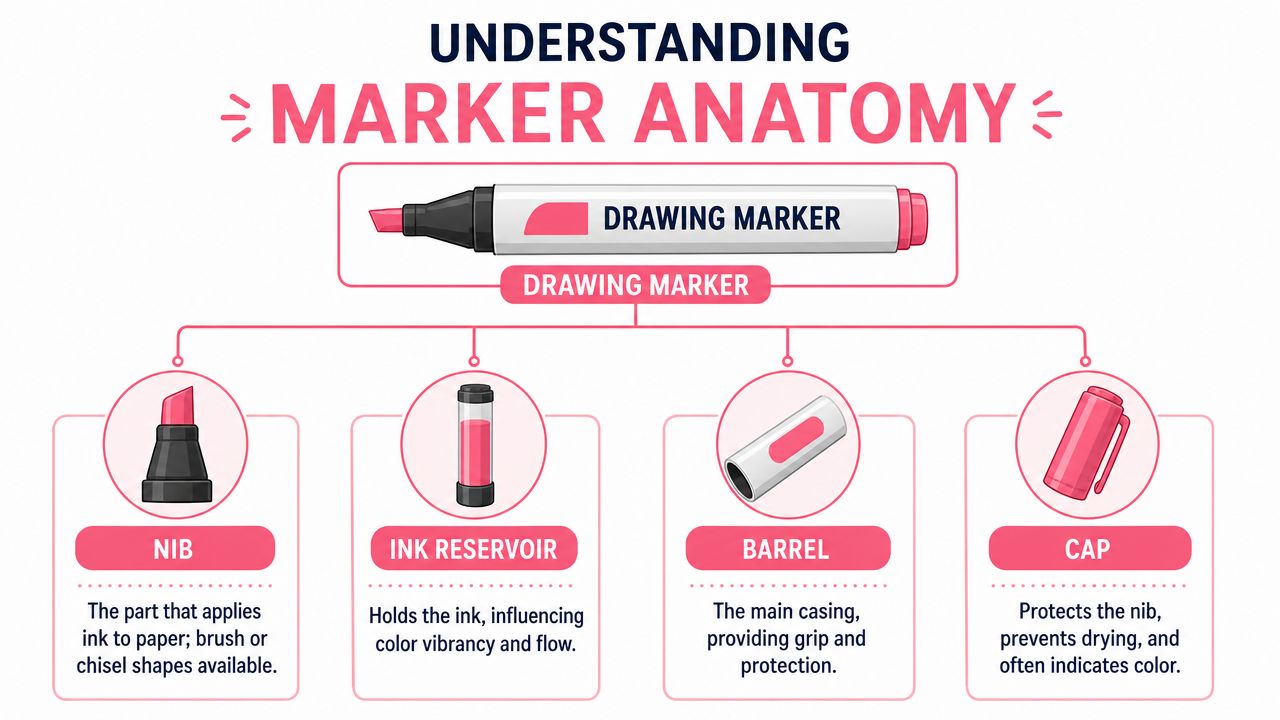
Before comparing brands, it helps to know what you're holding. Marker performance comes from a small set of parts working together: the nib, the ink inside, the barrel shape, and the cap seal. When one of those is weak, the whole drawing experience gets worse.
A Quick Comparison Table
| Marker feature | Best for | Strength | Trade-off |
|---|---|---|---|
| Alcohol-based ink | Blending, gradients, illustration | Smooth layering and soft transitions | More bleed and paper sensitivity |
| Water-based ink | Clean coloring, lettering, lighter paper use | Easier control, less bleed on many papers | Harder to get seamless blends |
| Brush nib | Organic strokes, character art, expressive fills | Line variation and better control in curves | Can wear faster with rough use |
| Chisel nib | Large areas, backgrounds, fast coverage | Efficient fills and edge control | Less comfortable for detailed rendering |
| Bullet nib | Details, outlines, smaller shapes | Predictable, firm feel | Not ideal for broad coverage |
| Refillable marker body | Long-term use, stable favorite colors | Better long-term system value | Higher upfront commitment |
| Disposable marker body | Casual use, low-friction buying | Easy to start with | Replacement gets messy over time |
Alcohol-Based vs Water-Based
If your goal is smooth shading, alcohol markers usually make more sense. They blend into each other more easily, which is why they dominate illustration, manga rendering, and polished adult coloring work.
Water-based markers do different jobs well. They're often easier for crisp fills, planner work, lettering, and paper that can't tolerate much saturation. If you've ever tried to force water-based markers to behave like alcohol markers, you already know the result. Patchy transitions, pilled paper, and frustration.
The phrase best drawing markers usually points people toward alcohol markers for a reason. They're built for layered color.
Nib Shapes Change How You Draw
Nib choice affects more than comfort. It changes your drawing habits.
- Brush nibs work best when you want thin-to-thick variation, softer edges, and better control around hair, fabric, or facial features.
- Chisel nibs are practical workhorses. They cover big shapes quickly and help with background blocking.
- Bullet nibs suit artists who want a firmer point and steadier detail work.
A dual-tip marker often gives the best balance for hobby artists because you get speed on one end and control on the other.
A brush nib sells the dream. A chisel nib often does more of the boring work that actually finishes the page.
Refillability and Real Ownership
Refillable markers matter most when you use the same colors again and again. Skin tones, shadow grays, foliage midtones, and base neutrals run out first in most collections. If your workflow depends on a repeat palette, refillability starts to matter a lot more than it seems on day one.
Colorless blenders also deserve a reality check. They're useful, but they're not magic. They can soften edges, lift some ink, and help transitions in specific situations. They won't rescue bad paper or a damaged nib.
The Great Marker Debate Copic vs Ohuhu and More
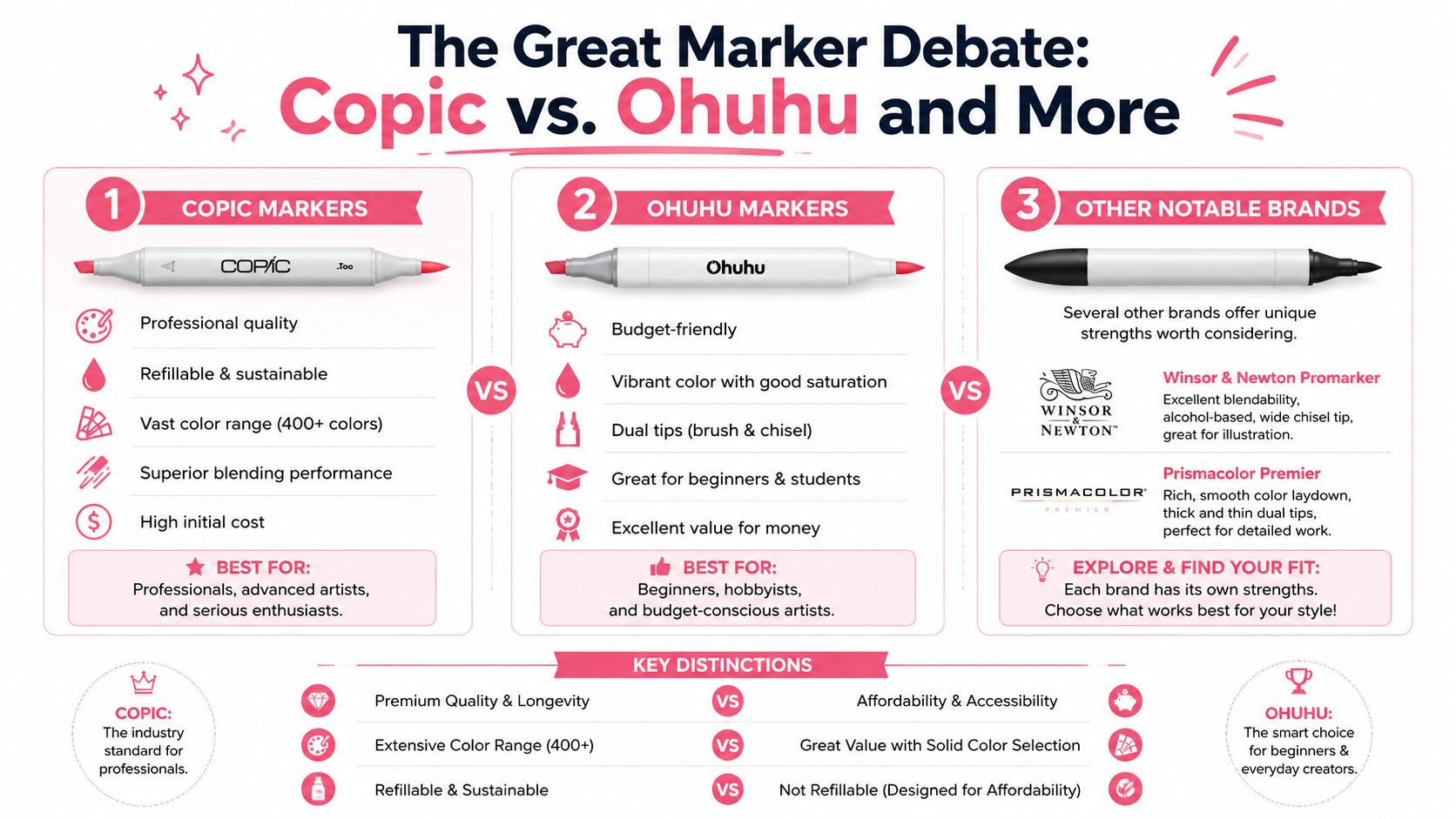
You feel this debate most on the third or fourth finished piece, not the first swatch card. A marker can look great out of the box and still become expensive once the brush tip softens, the favorite colors run dry, or replacement options are awkward. That is why the Copic vs. Ohuhu argument is really about long-term ownership, not just first impressions.
What Separates the Main Players
The easiest way to waste money on markers is to compare sticker price only. A cheaper set can stay cheap if you color casually and rotate through a wide palette. The same set gets expensive fast if you burn through a small group of skin tones, warm grays, and shadow colors every week.
| Brand | Best known for | Best fit | Main caution |
|---|---|---|---|
| Copic | Refillable system, replaceable nibs, proven consistency | Working illustrators and artists who reuse the same palette often | High upfront buy-in |
| Ohuhu | Strong performance for the price | Students, hobbyists, and artists building a large set quickly | Long-term replacement costs and system depth need a closer look |
| Prismacolor | Distinct feel and familiar brand presence | Artists who like its handling and color character | Availability and consistency can be less predictable |
| Winsor & Newton | Professional art-brand option with solid color quality | Artists who want a pro-tier alternative outside Copic | Set selection matters, and the ecosystem is not as widely adopted |
For side-by-side sorting by refillability, nib options, and set value, this marker comparison tool for art sets helps narrow down which system fits your budget and workload.
Where Copic Still Leads
Copic still earns its reputation because the whole system is built for repeat use. According to Art is Fun's review of alcohol marker brands, Copic came out as the benchmark in large-scale testing for low streakiness and strong blend uniformity.
That matches what shows up over months of use. Copic markers usually keep a more predictable ink flow, replacement nibs are easy to get, and refills make financial sense if you empty the same colors again and again. For professional work, or for hobby artists who have settled into a reliable palette, that matters more than hype.
The catch is obvious. The initial spend is high, and it can be hard to justify if you are still figuring out your style or only finish a few marker pieces each month.
Why Ohuhu Became the Value Favorite
Ohuhu earned its spot because the drawing experience is good, not because artists lowered their standards. Nienke Vletter's comparison of five alcohol marker brands describes Ohuhu as very close to Copic in blending performance, with especially friendly behavior on standard paper.
That makes Ohuhu a smart buy for a lot of artists. You get a large usable palette, brush options in many sets, and results that are strong enough for finished work, commissions, sketchbook practice, and classroom use.
The bigger question is what happens later.
If you are a heavy user, total cost starts shifting from purchase price to maintenance. Can you refill your most-used colors easily? Can you replace a worn tip instead of replacing the whole marker? Can you buy singles, or do you keep patching gaps by purchasing overlapping sets? Those questions favor Copic more often than beginners expect.
Ohuhu still makes sense for many artists because the entry cost is so much lower. For casual to moderate use, that savings is real. For high-volume use, Copic often catches up over time because the system wastes less money on duplicates and dead markers.
Where Other Brands Fit
Prismacolor and Winsor & Newton are still valid choices, but they usually make the most sense for artists with a specific preference, not for someone choosing a full system from scratch.
Prismacolor appeals to artists who like its color feel and marker body, but I would test it on your actual paper before committing. Winsor & Newton can suit artists who already trust the brand and want another professional option, but it does not dominate the conversation because the ecosystem is not as convenient for as many people.
For most buyers, the practical decision looks like this:
- Choose Copic if you use markers often enough to care about refills, replaceable nibs, and stable long-term costs.
- Choose Ohuhu if you want very good results now and need the best balance between performance and upfront price.
- Choose Prismacolor or Winsor & Newton if you already know you prefer their feel, colors, or brand ecosystem.
A mixed collection is often the smartest setup. Many artists keep premium workhorse colors in a refillable system, then use lower-cost markers for the broader palette they reach for less often. That approach saves money without giving up control where it counts most.
Matching Marker Sets to Your Artistic Goals
You feel the difference after a few weeks, not on day one. A set that looks perfect in swatches can become annoying fast if the skin tones run dry first, the brush nib frays on your paper, or half the colors never leave the case. The right choice depends on what you draw, how often you draw it, and what it costs to keep that set working.
For Manga and Character Art
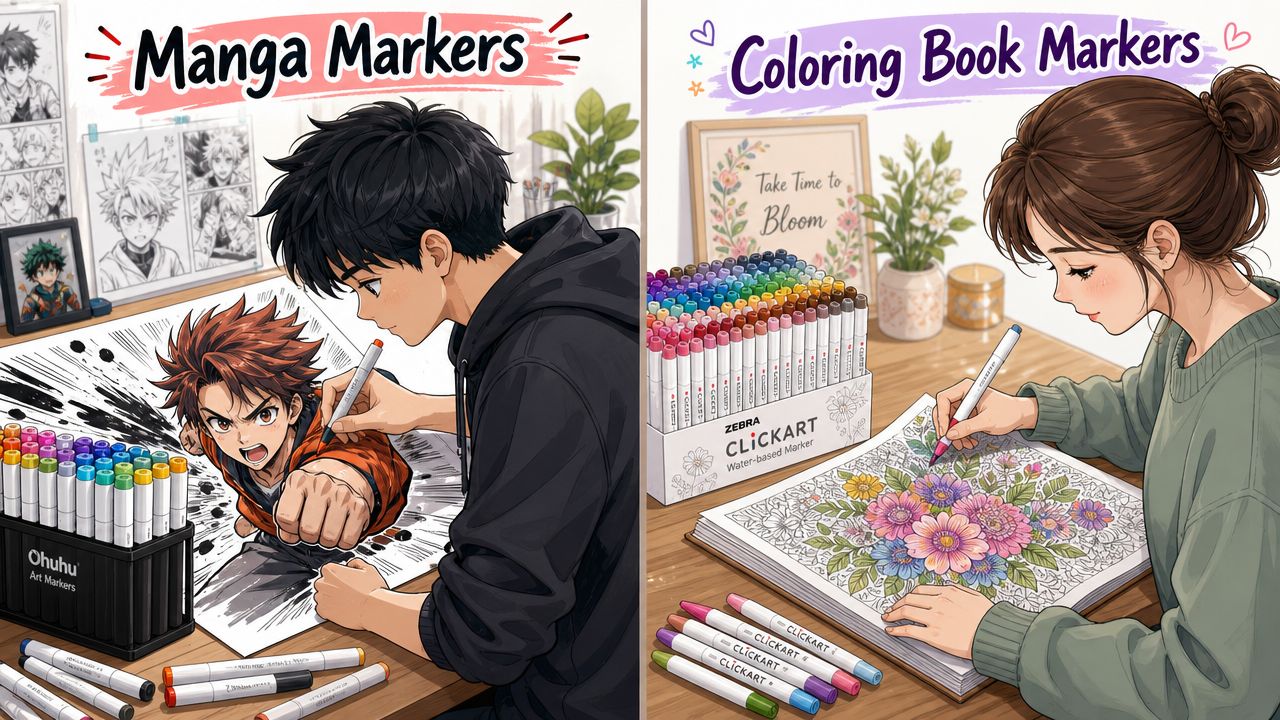
Character work exposes weak markers quickly. Faces, hair, folds, and soft shadow transitions ask a lot from a brush nib, and a stiff or worn tip starts fighting you long before the barrel is empty.
As noted earlier, Ohuhu has earned a strong reputation here. The bigger question is whether your set supports the colors you burn through. Character artists rarely use every hue evenly. Skin tones, muted browns, greys, blue-shadows, and a handful of hair colors disappear first, so replacement strategy matters as much as first-pass blending quality.
A practical manga setup usually includes:
- A tight core of skin tones you can layer cleanly
- Brush and chisel tips if you switch between details and larger fills
- Easy replacement options for the few colors that do most of the work
- A paper match that protects nibs instead of chewing them up
That last point affects cost more than beginners expect. If your paper roughs up brush tips, your line control drops and your best markers age early. For artists who draw characters often, that wear becomes part of the actual price of the system.
For Adult Coloring Books
Coloring books reward consistency more than range. You need markers that feel comfortable for long sessions, fill repeated shapes evenly, and give you enough light, dark, and neutral options to keep pages from looking flat.
Big budget sets can work well, but only if the palette is balanced. I would take a smarter 48 over a bloated 120 full of near-duplicate mids any day. Coloring artists often get more value from dependable everyday shades than from unusual accent colors they use once.
Bleed-through matters here too, especially on printed books with thin stock. Alcohol markers can still be a great fit, but they work best when you accept the trade-off and use a backing sheet. If you mix brands and want to match colors across systems, a DecoTime to Ohuhu color converter can save some trial and error.
For General Sketching and Learning
Artists still figuring out their style do not need a huge set first. They need a set they will use without feeling precious about every stroke.
Start with enough range to study form, temperature, and value. Then pay attention to what runs dry, which tips stay pleasant, and which colors sit untouched for months. That tells you more than any brand ranking because it reflects your real pages, your real paper, and your real habits.
A solid beginner plan looks like this:
- Buy a manageable set with useful warm and cool basics.
- Swatch it on the same paper you draw on.
- Track the colors you replace mentally by reaching for them over and over.
- Expand around those working colors instead of buying random add-on packs.
That approach saves money twice. You avoid paying for colors you never need, and you learn early whether your long-term cost problem is ink use, nib wear, or both.
Smart Selection Criteria Beyond the Brand Name
Brand names get too much credit. Paper, tip wear, and replacement logic often decide whether you enjoy a marker set six months later.
Paper Can Make Good Markers Feel Bad
A premium marker on bad paper can feel cheap. Fibrous paper snags brush nibs, causes feathering, and interrupts smooth blends. Thin pages turn every shadow pass into a bleed-through gamble.
Smooth marker paper and Bristol-style surfaces usually help alcohol markers behave the way people expect. If your marker tests looked disappointing, the paper may have been the problem.
Use one page for swatches, one page for layering tests, and one page for your normal line art. That tells you much more than a single scribble.
Think in Systems, Not Singles
The best drawing markers aren't just individual pens. They're a system that supports how you work.
Ask these questions before buying more:
- Can I replace favorites easily? Repeated-use colors matter more than novelty shades.
- Does the nib shape match my drawing habits? A beloved brand can still feel wrong in your hand.
- Will this work on my usual paper? Marker and paper always act like a pair.
- Am I paying for range or for repeatability? Those are different benefits.
Someone who colors a few pages each week can live happily with a simpler system. Someone who renders characters daily should think much harder about replacement strategy and nib wear.
The Hidden Cost of Tip Damage
This is the issue most reviews skip. A marker can test beautifully when new and become annoying long before the ink is fully gone.
A 2025 analysis of artist communities found that 18% of adult coloring book users replaced markers because of tip damage rather than ink depletion, according to this discussion of marker wear and long-term use. That one detail changes how I think about marker value.
If the brush tip frays, soft gradients get harder. Fine edges become fuzzy. Controlled flicks turn into blunt strokes. At that point, the marker may still contain ink, but it has stopped being useful for the jobs you bought it for.
Practical rule: judge a marker by how it behaves after repeated sessions, not by the first swatch.
So when you compare marker systems, think beyond sticker price. Think about how long the tip shape stays reliable, how often your favorite colors need replacement, and whether the set still feels good after months of real pages.
Your Workflow From Digital Plan to Final Art
Good marker work usually looks relaxed. Behind that relaxed result is planning.
Build a Repeatable Marker Routine
Start with a swatch chart. Not the tiny cap-color trust exercise, but a real swatch sheet on the exact paper you use most. Markers almost always look different on paper than they do on the barrel.
Then test three things:
- Single-layer color
- Two-layer deepening
- Blend with a neighboring shade
This takes a little time once, then saves a lot of frustration later. It also helps you spot which markers in your collection are best for base coats, shadows, and accents.
Keep a second page for “pairings that work.” Some marker combinations blend beautifully. Others just make mud. You want to learn that before you're halfway through a face or background.
Translate Digital Ideas Into Real Marker Choices
A digital preview can reduce wasted ink if you use it correctly. The trick is not to chase exact screen color. The goal is to test relationships: warm against cool, muted against bright, light against dark.
My preferred workflow is simple:
- sketch or choose line art
- decide the mood first
- pull a limited palette
- match those choices to physical markers
- swatch the final short list before touching the finished page
That process prevents the classic mistake of improvising too many color jumps midway through a piece.
If you work this way consistently, your markers start behaving less like random supplies and more like a dependable toolkit. That's when even a modest collection starts outperforming a huge unplanned one.
Frequently Asked Questions About Drawing Markers
Should Markers Be Stored Horizontally
Horizontal storage is the safer default for most drawing markers. It helps keep ink distribution more balanced across the nibs, especially in dual-tip markers. If a marker is stored upright for long stretches, one end can feel drier than the other.
If you use organizers, choose one that lets markers lie flat or rotate them regularly.
Can You Mix Brands in One Piece
Yes, and many artists do. Mixing brands works best when you understand what each marker does well. You might prefer one brand for pale skin blends, another for dark shadows, and a third for background fills.
The main thing to watch is nib feel and ink character. Some markers stay wetter on the surface longer, while others set faster. Test combinations on scrap paper before using them in finished work.
Does Lightfastness Matter for Hobby Art
It depends on your goal. If you're making pages for personal enjoyment, sketchbooks, or coloring books stored indoors, lightfastness usually isn't the first issue to worry about. Blending behavior, bleed control, and nib durability matter more day to day.
If you sell originals, display work near sunlight, or archive finished illustrations, lightfastness becomes more important. At that point, check each product line carefully rather than assuming all artist markers behave the same.
For most hobbyists, this priority order is more useful:
- First, choose markers that feel good to use
- Second, choose paper that supports them
- Third, think about long-term replacement and wear
- Then worry about specialized edge cases
The best drawing markers are the ones you'll keep reaching for. Not the ones that look most impressive in a haul photo.
If you want a calmer way to plan palettes before committing ink, ColorBestie is worth a look. It helps turn black-and-white sketches into marker-style color previews, aligns suggestions with popular marker brands, and makes it much easier to test ideas before you touch your final page.