You're probably staring at a shopping cart, a craft store shelf, or a dozen browser tabs and thinking the same thing most new colorists think. Why are there so many markers, and how am I supposed to know which ones won't ruin my book?
That confusion makes sense. Adult coloring has grown into a huge hobby, and by 2024 the global adult coloring book market reached about $1.5 billion, with marker-based coloring making up nearly 35% of hobbyist coloring activity. The same industry survey says 62% of adult colorists prefer alcohol-based markers for their blendability and saturation, which helps explain why shelves now feel packed with options, sets, tip styles, and brand names (National Association of Creative Arts survey summary).
If you're new, the hardest part isn't finding markers. It's knowing what happens after you buy them. Will they bleed? Will the brush tip feel floppy? Will your paper buckle? Will your colors work together, or will that page you loved suddenly feel off?
That's where a calm plan helps. Instead of chasing hype, think about your full coloring experience. Marker type matters. Paper matters just as much. Tip shape changes control. Palette planning can save a page before ink ever touches paper. If you want a digital helper later, tools like ColorBestie can also make color planning less stressful.
Welcome to the World of Color Finding Your Perfect Markers
A customer once came into the shop holding a coloring book in one hand and her phone in the other. She had one tab open for Copic, one for Ohuhu, one for Prismacolor, and one full of reviews arguing with each other. She didn't want “the best” in some abstract way. She wanted markers that would feel fun, look smooth, and not soak through her pages.
That's the core question behind most searches for the best markers for adult coloring. You're not just buying ink. You're buying a feeling. You want to sit down after a long day, open your book, and color without second-guessing every stroke.
Adult coloring has become much more marker-focused for a reason. Bright, smooth fills are satisfying. Layered shadows are easier to build. Pages can look polished fast. The hobby's growth has pushed brands to offer more dual-tip sets, softer brush nibs, and larger color libraries, which is great once you know what you're looking at.
The overwhelm is normal
Most beginners get stuck on the same few questions:
- Ink confusion: Should you choose alcohol or water-based?
- Tip confusion: Do you need brush, fine, bullet, or chisel?
- Brand confusion: Is Copic worth it, or is Ohuhu enough?
- Paper panic: Will your coloring book handle markers at all?
You don't need a perfect set. You need a set that matches how you actually color.
If you love tiny floral details, your needs are different from someone filling large mandalas. If you mostly color at the kitchen table, storage and smell matter. If you use budget-friendly books with thinner paper, your marker choice has to respect that.
What a good choice feels like
The right marker set usually gives you three things right away:
- Confidence: You stop hovering over the page and start coloring.
- Control: The tip does what your hand expects.
- Consistency: Colors go down evenly and behave in a predictable way.
That last point matters more than people think. Beginners often blame themselves for streaks, feathering, or blotchy blending when the underlying issue is a mismatch between ink, paper, and tip style.
So if you're overwhelmed, you're not behind. You're at the normal starting point. The good news is that once you understand a few core ideas, the marker aisle gets much less mysterious.
The First Big Choice Alcohol vs Water-Based Markers
This is the fork in the road. Before brand names matter, you need to know what kind of marker experience you want.
Alcohol markers are usually the better fit when you want smooth, saturated color. A large comparison of markers notes that alcohol markers are technically suited to adult coloring because their dye-based ink and low-viscosity solvent carrier create better layer fusion than water-based fineliners (independent marker comparison by Sarah Renae Clark).
How they behave on paper
Think of alcohol markers as fast, fluid color. They glide. They spread evenly. When you overlap similar shades, they tend to melt into each other more naturally.
Water-based markers feel more controlled at first. They can be gentler on paper, especially in lighter applications, and many people like them for crisp details, journaling, and smaller spaces. But they don't usually blend with the same silky look alcohol markers can create.
Here's a simple mental shortcut:
- Alcohol markers: Better for smooth fills, soft gradients, and rich saturation
- Water-based markers: Better when you want a gentler paper experience and simpler control
Why beginners get mixed advice
A lot of reviews answer different questions without saying so. One person is judging blend quality. Another cares about smell. Another is coloring in bargain books with thin pages. Another uses heavy cardstock and wants dramatic shading.
That's why “best” can sound contradictory.
Practical rule: If your dream result is velvety blends and vivid pages, start by looking at alcohol markers. If your top fear is paper damage, look closely at water-based options and paper-friendly setups.
Which one fits your style
Ask yourself what you enjoy most:
You love gradients and depth.
Alcohol markers will probably feel more rewarding.You mostly fill small shapes and outlines.
Water-based markers may feel easier right away.You color to relax and don't want technical fuss.
Either can work, but your paper quality will shape the result more than most beginners expect.You want one versatile setup.
A dual-ended alcohol marker with the right paper often gives the broadest creative range.
One more thing trips people up. “Permanent” and “blendable” can exist together in alcohol markers. They dry quickly, but while you're working, the ink can still blend beautifully if you move at a steady pace.
That doesn't mean water-based markers are lesser. They're different tools. If alcohol markers are like smooth transparent glaze, water-based markers are more like controlled color application with less aggressive penetration into the page.
A Deep Dive into the Top Brands Copic Ohuhu and More
When people compare the best markers for adult coloring, they often jump straight to rankings. That misses the more useful question. Which brand feels right in your hand, on your paper, and within your budget?
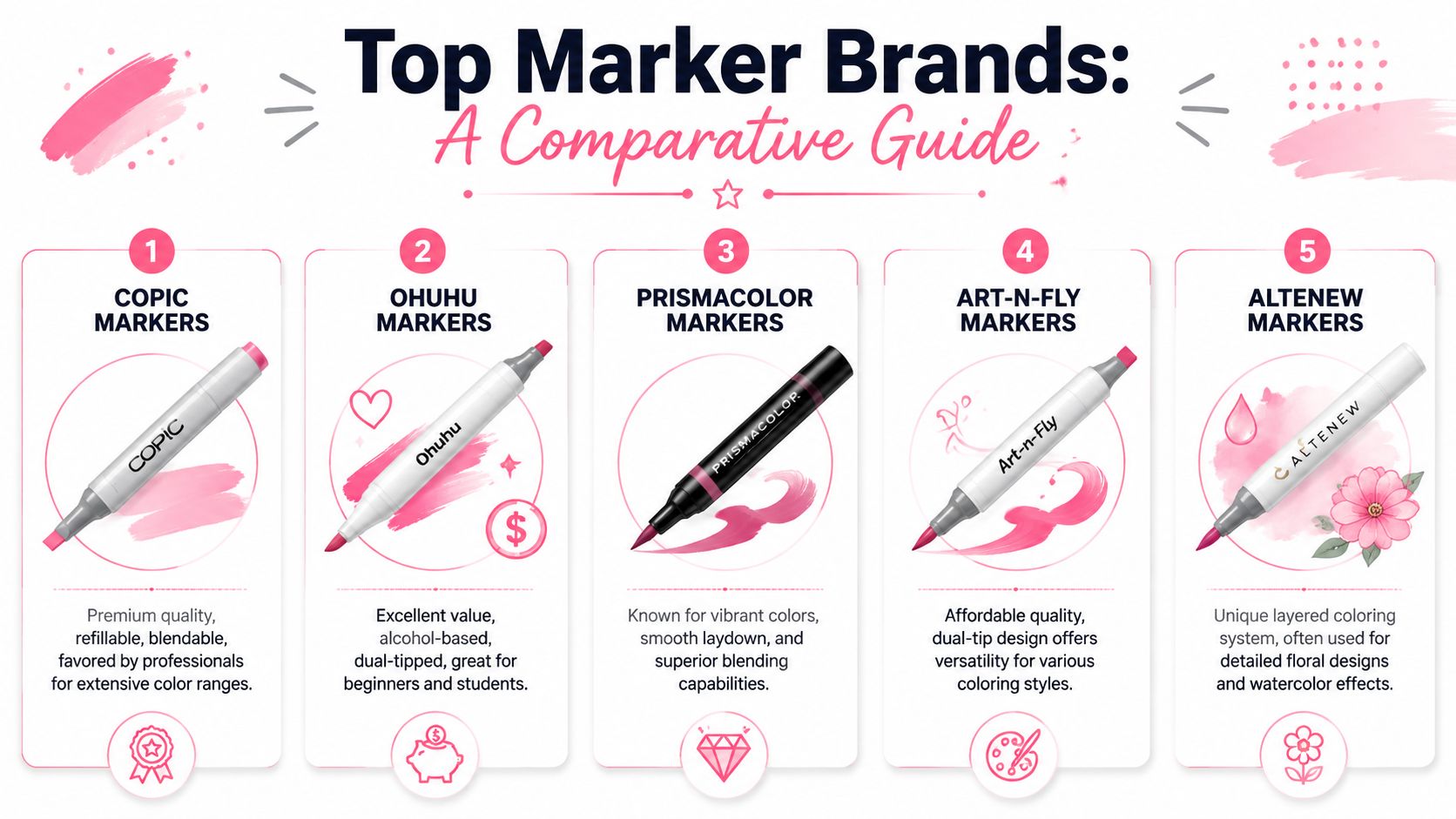
A practical review notes that dual-ended alcohol markers with a brush tip and a chisel tip offer the best control tradeoff for adult coloring, because the brush tip handles curved fills while the chisel tip speeds up larger areas. The same review points out that a Copic Ciao dual-ended set such as a 12-piece skin-tone set sells for roughly $55, which shows how professional-grade pricing differs from value-focused alternatives (ColorIt review of marker choices for adult coloring).
What matters more than the logo
Before looking at brands one by one, keep your eye on five things:
- Ink feel: Does the color lay down evenly, or does it fight you?
- Tip setup: Brush and chisel is versatile. Fine tips help with tight detail.
- Color range: More colors sound exciting, but a balanced set is often more useful than a giant one.
- Upgrade path: Some people want refillable systems and replaceable nibs. Others just want a good starter box.
- Budget comfort: If you're nervous every time you uncap a marker, the set may be too expensive for relaxed coloring.
Marker Brand Comparison at a Glance
| Brand | Ink Type | Average Price per Marker | Tip Options | Best For |
|---|---|---|---|---|
| Copic Ciao | Alcohol-based | Premium | Brush and chisel | Colorists who want a long-term investment |
| Ohuhu | Alcohol-based | Value-oriented | Brush, chisel, and some fine-tip options by set | Beginners and hobbyists who want lots of color for the money |
| Prismacolor | Alcohol-based | Mid to premium | Fine and chisel | Rich color and smooth laydown |
| Spectrum Noir | Alcohol-based | Mid-range | Varies by line | Hobby colorists who want brand variety and themed sets |
| Winsor & Newton | Alcohol-based | Premium | Brush and chisel in select lines | Artists who care about smooth professional feel |
If you want to compare marker systems side by side while you shop, this marker comparison tool can help you sort through popular sets.
How each brand feels in real use
Copic Ciao
Copic is the brand many people dream about first. The appeal is clear. The markers feel refined, the brush nib is well loved, and the system is built for people who treat markers as a long-term medium, not a one-box purchase. If you color often, like precise color naming, and want a professional ecosystem, Copic makes sense. The drawback is simple. Price can make beginners hesitant to experiment.
Ohuhu
Ohuhu is often the easiest recommendation for new colorists who want alcohol markers without immediately making a premium investment. The brand is widely associated with generous sets and approachable pricing. If your goal is to practice blending, learn layering, and enjoy a wide palette early, Ohuhu often feels welcoming rather than precious.
Prismacolor
Prismacolor markers tend to attract people who want vibrant color and smooth application. Their fans often like the richness of the laydown and the overall feel of coloring with them. If your pages include flowers, leaves, and decorative motifs where saturation matters, Prismacolor can be a satisfying middle ground.
Some brands are “better” on paper. Others are better for your confidence. Confidence matters more when you're learning.
Spectrum Noir
Spectrum Noir tends to appeal to hobby crafters and colorists who enjoy themed collections and accessible creative tools. It's a brand people often explore once they know they like markers and want to branch out without stepping straight into the most expensive option.
Winsor & Newton
Winsor & Newton often attracts the artist who already trusts the brand from other media. If you like polished tools and care about overall handling, it's worth considering. For many casual colorists, though, the decision often comes down to whether the added cost matches how often they'll use the set.
If you're still stuck, choose the brand that makes practice easiest, not the one that sounds most impressive. A marker you'll happily use every week beats a marker you're afraid to “waste.”
Your Canvas Choosing the Right Paper and Tools
Good markers can't rescue bad paper forever. Many coloring frustrations stem from this issue.
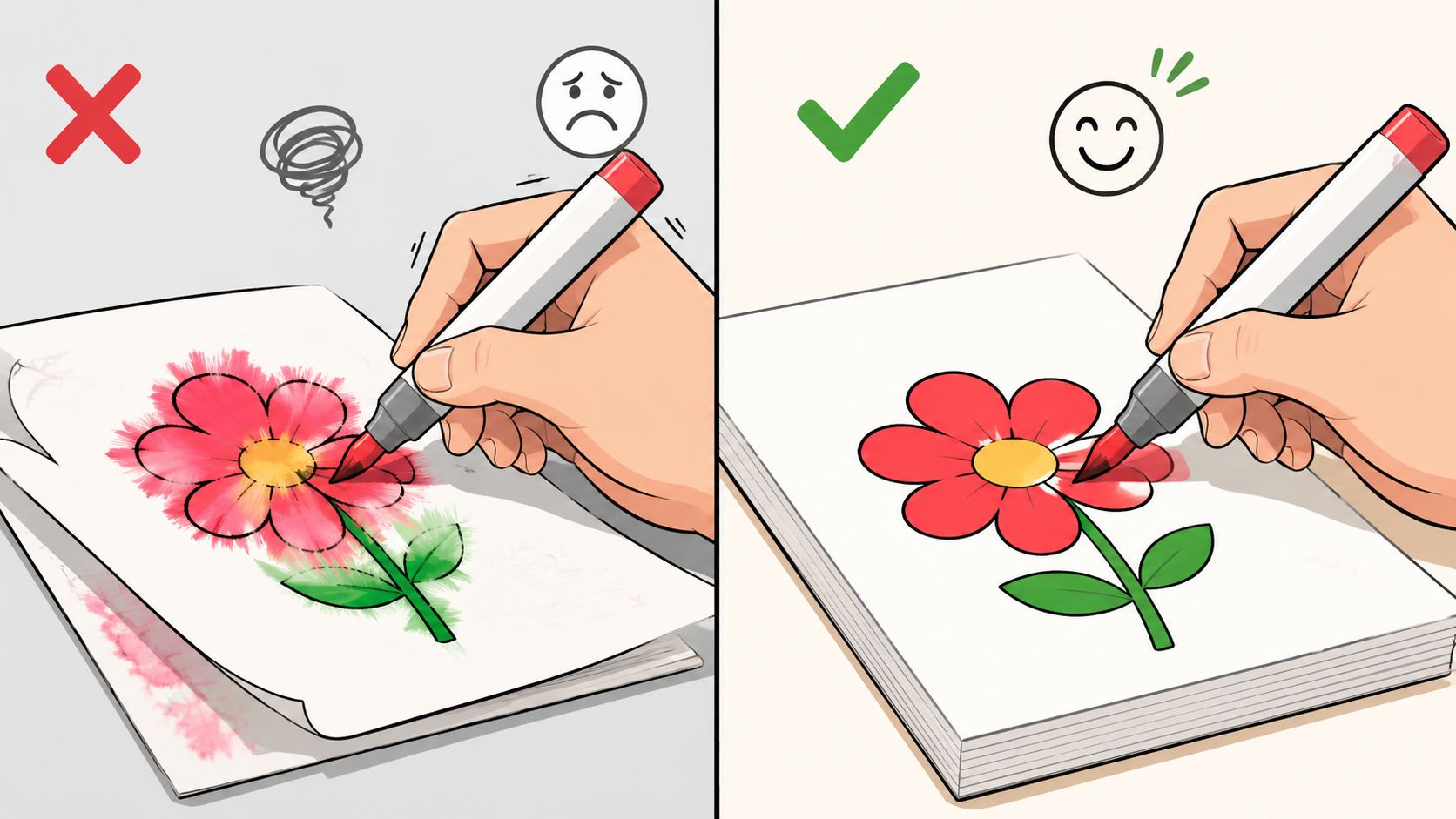
A 2025 study published in The Journal of Creative Materials found that 92% of alcohol-based markers bled through standard 80-lb paper, while 12% of water-based markers showed similar bleeding on smooth, heavy surfaces. The same research found that 88% of colorists who switched to 100-lb paper reported zero bleeding (Journal of Creative Materials research summary).
Paper can make good markers look bad
If you've ever used a nice marker on a cheap page and thought, “Why is this feathering and soaking through?” the marker might not be the villain.
Thin, porous paper drinks ink fast. That leads to bleed-through, fuzzy edges, and a back side you can't use. Heavier, smoother paper gives ink a better surface to sit on and move across.
That matters especially for alcohol markers. Their strength is fluid coverage. On the wrong page, that same fluidity becomes a problem.
Here's the plain-language version:
- Heavier paper usually handles markers better
- Smoother paper usually gives cleaner edges
- Thin coloring book paper often needs a protective sheet underneath
If you love alcohol markers, paper choice is not optional. It's part of the marker purchase whether the packaging says so or not.
Simple tools that save frustration
You don't need a giant supply haul. A few small additions can make coloring smoother.
- Blotter sheet or scrap cardstock: Slide it behind the page you're coloring. This won't stop bleed-through on the active page, but it helps protect the next one.
- Swatch sheet: Test colors before they touch your book. Caps and ink can differ.
- Colorless blender: Useful for softening transitions and pushing color, especially with alcohol markers.
- A good case or tray: Organized markers are easier to reach, which means you'll use more of your set.
For existing coloring books, your best move is to test first. Try a light patch in the margin or on a publisher sample page if one exists. If the paper feels soft and absorbent, don't assume premium markers will behave like they do on marker paper.
Some beginners think buying more expensive markers will solve every issue. Often, spending attention on paper solves more than spending extra on ink.
From Beginner to Pro Essential Coloring Techniques
Skill with markers doesn't come from pressing harder. It comes from learning how ink wants to move.
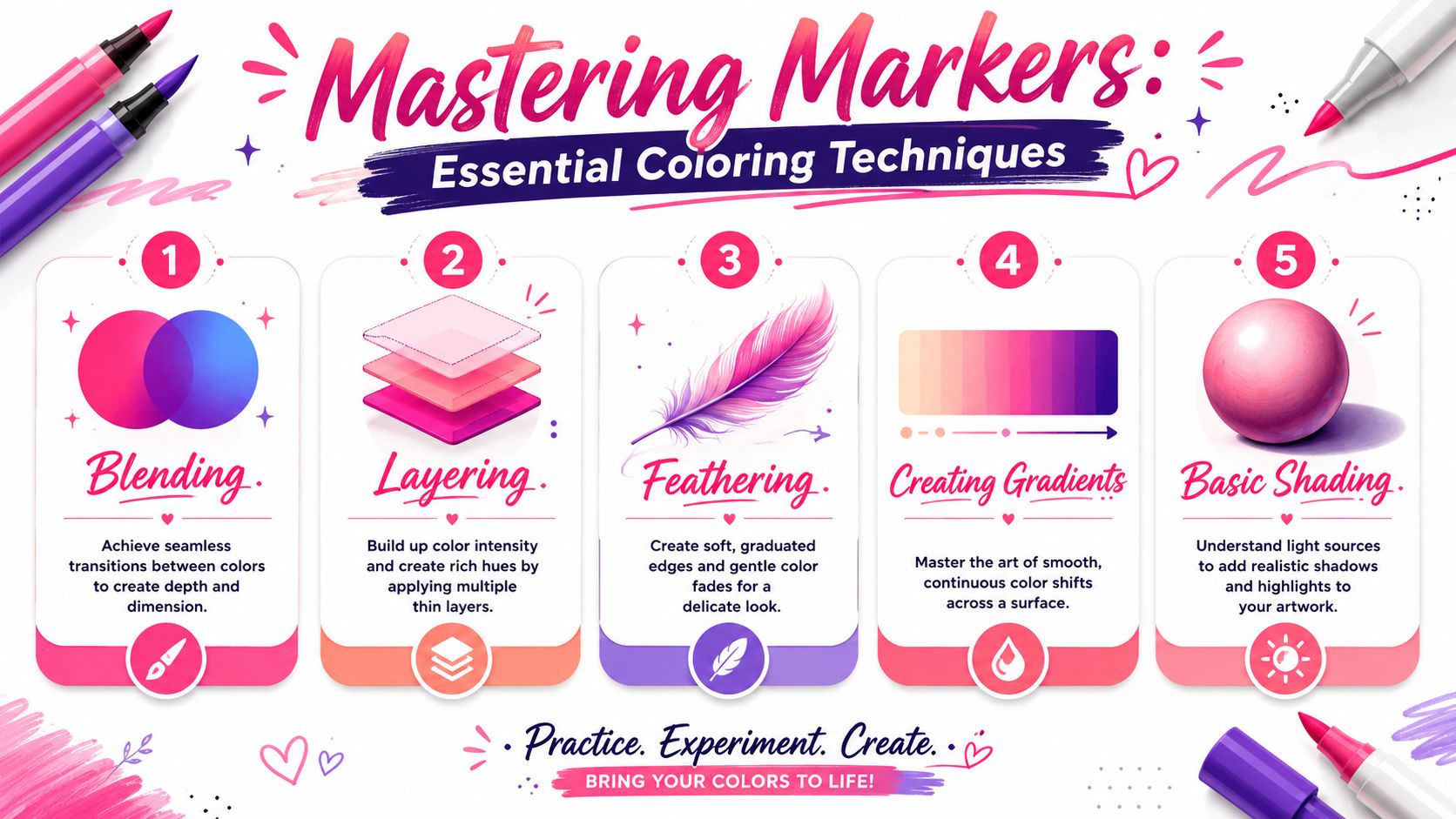
To make that easier, keep this visual nearby while you practice.
Blending without mud
The biggest beginner mistake is waiting too long between colors. Alcohol markers blend best when the first layer is still workable.
Try this simple method:
- Lay down your lighter color first.
- Add the darker color where the shadow should sit.
- Go back with the lighter marker and overlap the edge between them.
- Use small, controlled strokes instead of scrubbing.
If the transition looks streaky, don't panic. Let it dry. Then add another light pass. Many blends improve when you stop fussing with them.
A second method works well on petals and leaves. Use a flicking motion from dark into light. That creates a softer edge and keeps the page from looking airbrushed in a stiff way.
Layering for depth and softness
Layering is simpler than blending and often more useful in adult coloring books. You build color slowly instead of trying to nail the final look in one pass.
Good places to layer:
- Under overlapping petals
- Along folds in fabric
- Near corners, frames, and decorative borders
- At the base of leaves or stems
Store-counter advice: Color the whole shape first. Then add depth. Beginners often jump straight to shadows and end up chasing uneven patches.
If you work with small motifs, layering can be enough on its own. A flower can look rich with one base color and one slightly deeper shade. You don't need a dramatic gradient on every element.
The same goes for highlights. Sometimes the best highlight is the paper left untouched.
A quick video can help if you learn better by watching hand movement and stroke direction:
Care that keeps markers usable longer
Marker maintenance sounds boring until a favorite shade dries out halfway through a page.
Keep it simple:
- Store horizontally when possible: This helps ink stay more evenly available to both ends.
- Cap immediately: Even short uncapped pauses can dry a nib.
- Use light pressure: Pushing hard frays tips and roughs up paper.
- Clean your workflow: Swatch first so you don't keep recorrecting with extra layers.
If you buy a premium system with refill options or replaceable nibs, maintenance becomes part of protecting your investment. If you buy value sets, good storage still matters. Either way, gentle handling gives you a better drawing experience and more consistent results.
Plan Your Palette with ColorBestie From Digital to Physical
For many people, the hardest part of coloring isn't technique. It's choosing colors before they touch the page.
That hesitation is more common than most guides admit. A 2026 survey by the Cozy Coloring Guild found that 74% of users prefer markers that support palette-based relaxation over pure performance metrics, highlighting a growing desire for a calmer, more guided coloring experience (Cozy Coloring Guild survey summary via JMC Colors).
Why palette anxiety stops people cold
A lot of unfinished pages don't fail because the artist lacked skill. They stall because the color plan never felt settled.
You might know this feeling already:
- You love the line art.
- You pick one color.
- Then the next choice feels risky.
- Suddenly the page sits untouched for a week.
That's the “what now?” problem after buying markers. The set is there. The book is there. Your mood is ready. But the palette isn't.
How digital planning helps physical coloring
A planning tool can feel less like tech and more like a sketchbook companion. The palette generator for coloring ideas is useful because it lets you test a direction before you commit ink. That matters with markers, since they don't erase and their final look depends on both paper and neighboring colors.
What makes digital previewing helpful is the bridge between inspiration and real supplies. A color idea is only useful if you can recreate it with markers you own or plan to buy.
That bridge matters for cozy coloring especially. Some evenings you don't want to engineer a palette from scratch. You want a soft floral mood, a warm café look, a dusky fantasy page, or a gentle pastel spread. Planning ahead can turn the session back into what it should be: relaxing.
A good palette plan lowers the pressure. Lower pressure usually leads to better coloring.
Digital planning also teaches your eye over time. You start noticing why one green works with a dusty pink and another doesn't. You get faster at spotting when a page needs contrast, when it needs restraint, and when a limited palette will look more elegant than using every marker in the case.
That learning carries back into physical coloring. You stop buying only by brand hype and start building toward the kinds of pages you want to make.
Your Perfect Set and Frequently Asked Questions
Choosing the best markers for adult coloring gets easier when you stop asking “What's best?” and start asking “What fits the way I color?”
Which set fits your style
If you're budget-conscious and new to alcohol markers
Ohuhu is often the easiest starting point. You get access to the alcohol-marker experience without the pressure of a premium investment. That makes practice easier, and practice matters more than prestige when you're learning blends, layering, and color control.
If you want a long-term art tool you can grow into
A starter Copic Ciao set makes sense. It's the kind of choice people make when they already know they enjoy markers and want a more established system with a professional feel. You'll likely pay more, but you may also feel more committed to building a real marker habit.
If detail work matters most to you
Look closely at sets with dependable fine tips or firm control on the brush end. Intricate florals, tiny pattern books, and decorative borders reward precision more than giant color counts.
If you mostly color to relax after work
Pick the set that feels easy to use, easy to organize, and emotionally low-pressure. A “better” marker that makes you tense isn't better for your hobby.
Frequently asked questions
Can I mix different brands of alcohol markers?
Yes. Many colorists do. The main thing to watch is how differently each brand's tips, saturation, and naming systems feel in practice.
Do I need a brush tip?
Not always, but many people enjoy it for curved shapes and organic fills. If you color lots of petals, leaves, hair, or flowing designs, a brush tip is helpful.
Is a fine tip necessary?
For intricate adult coloring pages, it often is. Fine control helps around printed lines, tiny spaces, and repeated motifs.
How do I reduce strong marker odor?
Color in a ventilated room, cap markers promptly, and take short breaks. If scent is a big concern, water-based markers may feel more comfortable for you.
Will expensive markers automatically stop bleeding?
No. Paper has a huge say in that result. A premium alcohol marker on poor paper can still bleed badly.
Should I buy the biggest set first?
Usually not. A manageable set teaches you more because you learn to combine colors thoughtfully instead of reaching for endless near-duplicates.
The best setup is the one that helps you finish pages, enjoy the process, and come back tomorrow wanting to color again.
If you want help turning “I bought markers, now what?” into a calm, fun routine, try ColorBestie. It helps you preview cozy palettes, match ideas to real marker brands, and plan colors before you touch the page, so coloring feels more relaxing and less like a guessing game.