You know that moment in the marker aisle when every cap looks promising, every set claims to be the answer, and you still leave more confused than when you walked in? That's usually the point where artists stop shopping for best markers for illustration and start buying on instinct. The problem isn't that there are too few options, it's that the marker market is crowded enough that a casual choice can lock you into a workflow that fights you every time you color.
| Brand | What it's good at | Main trade-off | Best fit |
|---|---|---|---|
| Copic | Smooth blending, refillable system, professional consistency | Higher upfront commitment | Professional use, serious daily practice |
| Ohuhu | Strong value, reliable blending, broad hobbyist appeal | Less premium system depth | Beginners and hobbyists building a set |
| Prismacolor | Bold color, familiar name, solid illustration feel | Less system flexibility | Artists who want classic alcohol-marker results |
The tricky part is that the right marker isn't just about the barrel in your hand. It's about how the ink behaves, how the colors scale from sketch to finished piece, and whether you can plan a palette before you ever touch paper. Alcohol markers dominate that conversation for a reason, and if you're trying to color manga panels, concept sketches, or polished illustration work, that matters more than flashy packaging.
The Quest for the Perfect Illustration Marker
You're standing in front of a screen or a store shelf, and every set seems to promise smooth blends, vibrant fills, and “artist quality.” Then you start reading reviews and realize the category is much bigger than you expected. One detailed comparison claims to have tested 2,800+ markers across brands and types, which says a lot about how serious and crowded this market has become, and why artists need a cleaner way to sort through it all. Sarah Renae Clark's marker comparison
That scale changes how people buy. Marker choice isn't just about finding a decent pen anymore, it's about matching ink behavior, nib feel, color range, and refill strategy to the kind of work you make. A beginner trying to color character art doesn't need the same system as a professional illustrator who refills favorite colors month after month.
Why the old “just buy a set” advice falls apart
A cheap set can look fine in a product photo and still feel wrong once you start layering. A premium set can be technically excellent and still be a poor buy if it doesn't fit your budget, your paper, or your style of rendering. The point is not to chase the most famous name first, it's to understand what kind of marker system supports your drawings instead of slowing them down.
Practical rule: choose for your workflow first, then for the brand.
That's why a practical guide has to start with the medium, not the logo. Alcohol markers, water-based markers, and hybrid systems all behave differently on the page, and those differences matter more than marketing copy when you're trying to finish a clean piece. Once the category is right, the brand decision becomes much simpler.
Understanding Marker Types Alcohol vs Water-Based
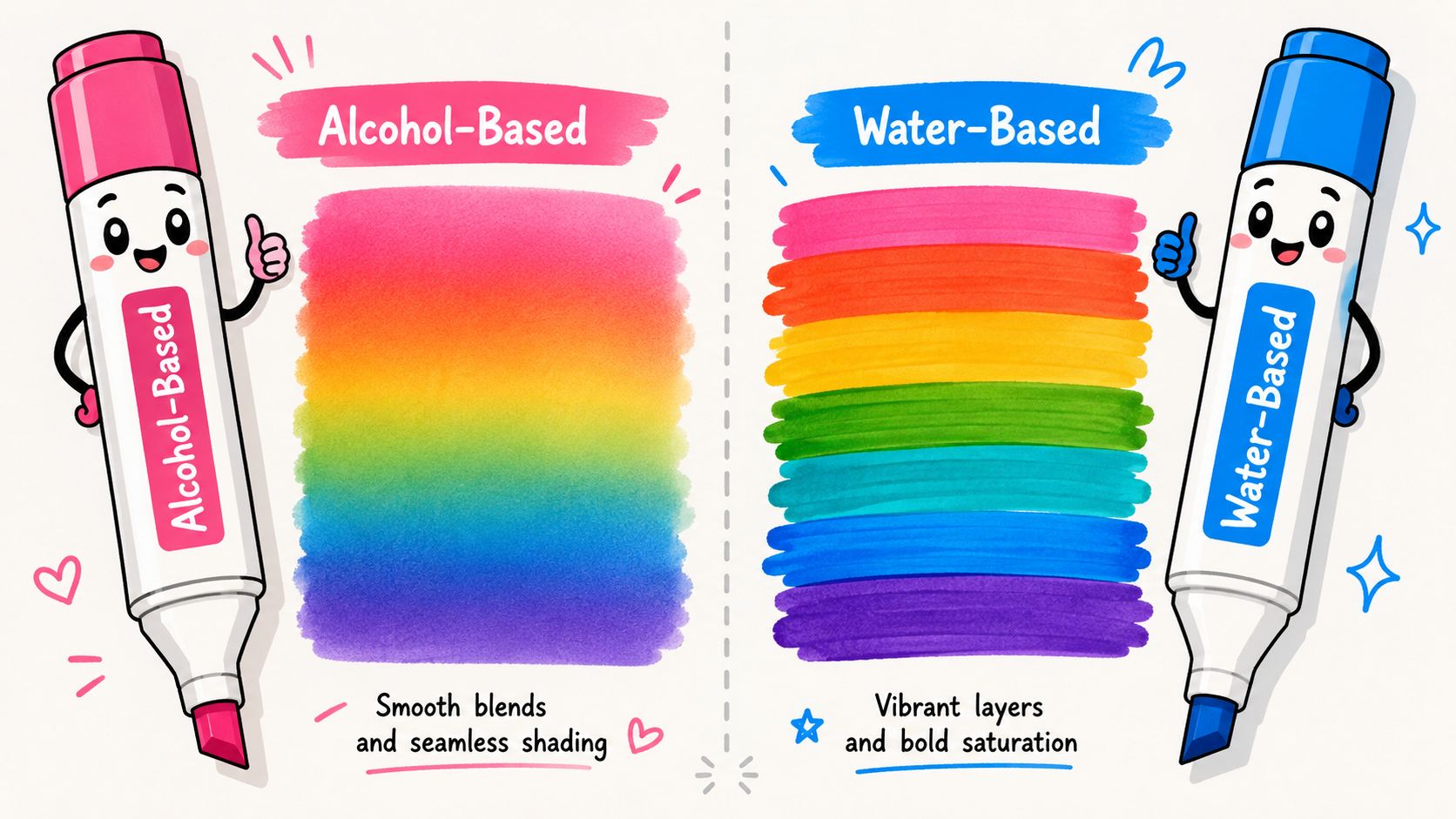
Alcohol markers sit at the center of modern illustration workflows because they dry fast, cover smoothly, and blend cleanly enough for polished gradients. Independent marker guides specifically note that they're preferred for illustration, comics, manga, design renderings, and polished gradients. Their performance as a rendering tool, distinct from a craft marker, explains why many artists repeatedly choose them. Drafting Supplies Dew on alcohol, water, and xylene markers
What alcohol markers do well
Alcohol-based systems are the strongest fit when you want a layered, controlled finish. They're built for smooth blending, vivid fills, and the kind of coverage that makes line art feel intentional instead of patchy. A major marker guide also frames alcohol markers as the category that became the preferred standard in professional art workflows, especially for comics and illustration. Alabama Art Studio Notes on markers
That matters because the best markers for illustration usually need to do three things at once, cover well, merge colors cleanly, and stay predictable as you move from swatch to finished piece. Alcohol markers do that better than water-based brush pens in most marker-heavy rendering workflows. If your goal is a manga portrait, a comic panel, or a clean concept mockup, this is the category that fits.
Where water-based markers fit instead
Water-based markers aren't bad, they're just built for a different job. They're often a better fit for journaling, softer wash effects, or mixed-media work where you want a more watercolor-like response. If you buy them expecting alcohol-marker blending, you'll probably feel frustrated quickly.
Water-based markers can be useful tools, but they're not the same thing as illustration markers built for controlled blending.
The practical takeaway is simple. If your art depends on smooth overlaps, crisp shadow transitions, and repeatable marker rendering, start with alcohol markers. If your style leans toward loose washes, brush lettering, or journal pages, water-based markers may feel more natural. The category decides the experience before the brand ever enters the picture.
The Big Three A Deep Dive Comparison
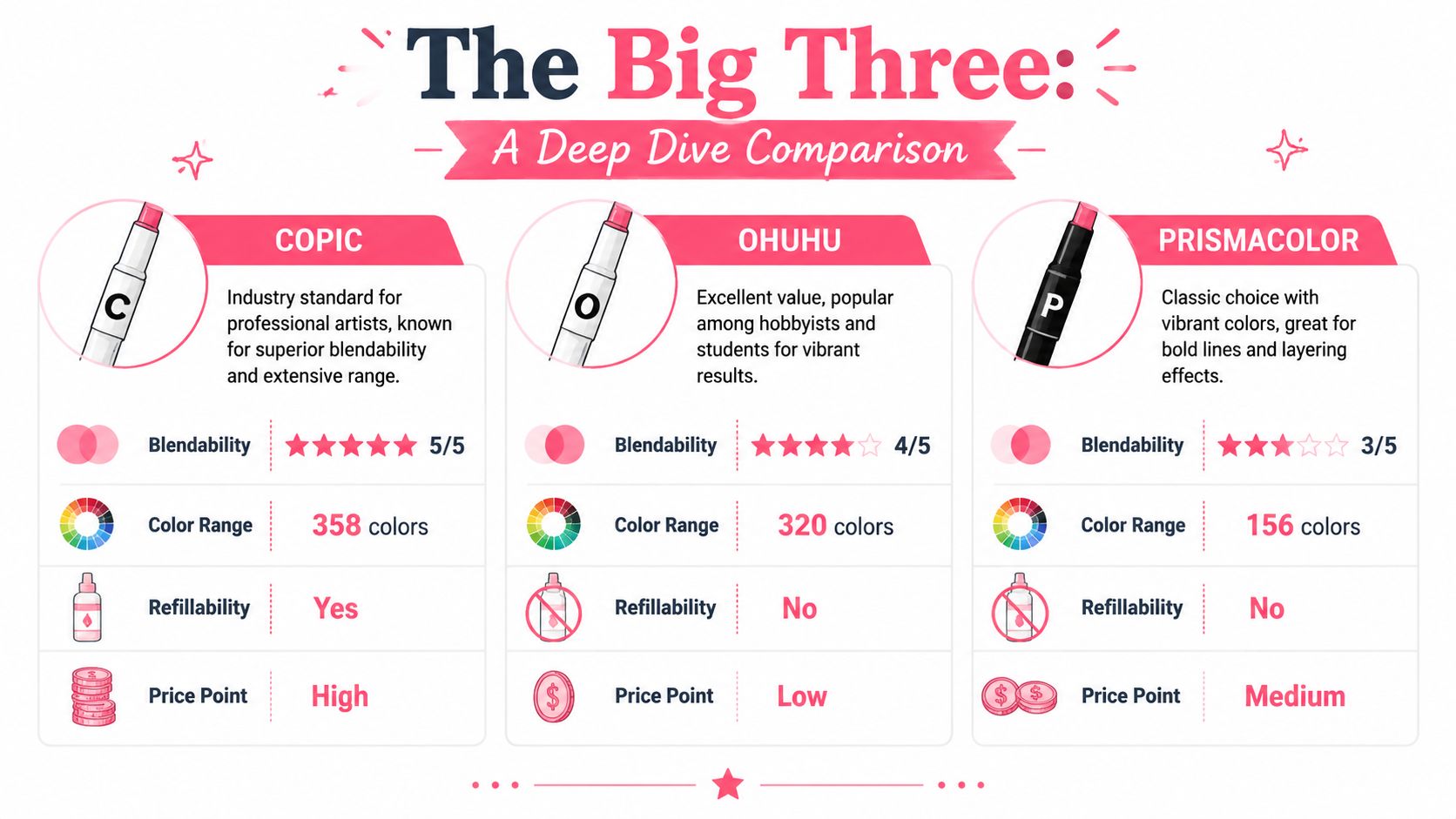
The honest comparison starts with a hard truth. These three names dominate a lot of illustration conversations because they each solve a different problem, and none of them solves every problem equally well. If you're choosing between Copic, Ohuhu, and Prismacolor, you're really choosing between premium system depth, value-driven access, and classic marker familiarity.
Copic
Copic is the reference point for a reason. The brand sits at the high end of professional marker use, with refillable bodies and replaceable nibs that support long-term studio workflows. That system design matters more than people expect, because once you've committed to favorite colors, the ability to maintain and restore them changes how you build a kit over time. Alabama Art Studio Notes on markers
Trade-off: Copic rewards commitment. If you want a marker system you can maintain instead of replace, it makes sense. If you want a low-friction starter buy, it can feel like too much too soon.
Copic also fits artists who care about consistency across repeated sessions. The ink response is the kind of thing illustrators notice immediately when they're layering skin tones, shadows, or polished gradients. The downside is obvious, the brand asks for a bigger upfront decision, and that can be intimidating if you're still figuring out your style.
Ohuhu
Ohuhu is the brand that makes alcohol-marker work accessible without feeling disposable. Hobbyists often gravitate to it because the value proposition is easier to justify, and the ink flow and blending behavior are strong enough for serious practice. In real-world use, that makes it a practical bridge between entry-level experimenting and more committed marker rendering.
Ohuhu's biggest strength is that it lowers the barrier to learning. You can practice swatching, layering, and palette planning without treating every stroke like an expensive mistake. That matters more than people think, because learning marker technique requires repetition, not perfection.
Prismacolor
Prismacolor keeps its place because it feels familiar and workable for a lot of illustrators. It's often associated with bold color and a straightforward marker experience, which makes it appealing if you want strong results without getting lost in system complexity. For some artists, that's the right balance.
The limitation is that it doesn't offer the same long-term system depth as a refillable professional setup. The ability of Prismacolor to make good art is not in doubt; it can. The question remains whether you want a classic marker experience or a system you can expand and maintain over time.
If you're comparing all three on paper, don't ask which is “best” in the abstract. Ask which one matches your hand, your budget, and how often you actually finish marker pieces.
If you want to compare marker sets more directly while planning a purchase, ColorBestie's marker comparison tool can help you line up options before you commit to a physical set.
Choosing Your Ideal Marker Set by Use Case
The right marker set depends less on prestige and more on where you are in your drawing life. A beginner needs room to learn. A hobbyist needs a set that feels rewarding enough to use often. A working illustrator needs reliability, maintainability, and the confidence that the colors on the page will behave the way the brain expected them to.
Beginner
If you're just getting started, Ohuhu is the most forgiving place to begin. It gives you enough quality to learn blending and layering without making every practice page feel like a costly test. That matters because early marker work is mostly about learning pressure, overlap, and how fast your ink settles on the page.
Start with a medium-size set if you can, not because bigger is automatically better, but because a starter palette needs enough color variety to teach you relationships between warm, cool, light, and dark tones. A tiny set can box you in before you understand what you enjoy drawing.
Hobbyist
If you already know you like alcohol markers and you're building a more intentional practice, Prismacolor can make sense if you want a familiar, accessible feel with strong visual payoff. It's a good fit for artists who enjoy bold, straightforward rendering and don't need the most advanced system features. That said, if you're aiming to grow into a more specialized marker workflow, Copic often becomes the next logical step.
Professional or serious aspirant
Copic is the strongest match for artists who draw regularly and want a system that can grow with them. Refillability and nib replacement are not luxury features, they're workflow features. They let you keep favorite colors in circulation instead of constantly re-buying whole sets.
For frequent use, maintenance matters as much as color range. A marker that can be kept in rotation is often a better studio choice than a cheaper marker that gets replaced every time it dries out.
If you're still undecided between set styles, the DecoTime to Ohuhu converter can be useful when you're trying to map one palette language to another before buying.
From Digital Idea to Physical Color with ColorBestie
Picking markers is only half the job. The other half is deciding which colors to use so your sketch doesn't turn into a pile of random swatches and guesswork. That's where a digital planning step saves real time, because marker work gets much easier when you've already thought through the palette before the first stroke hits paper.
A cleaner way to plan color
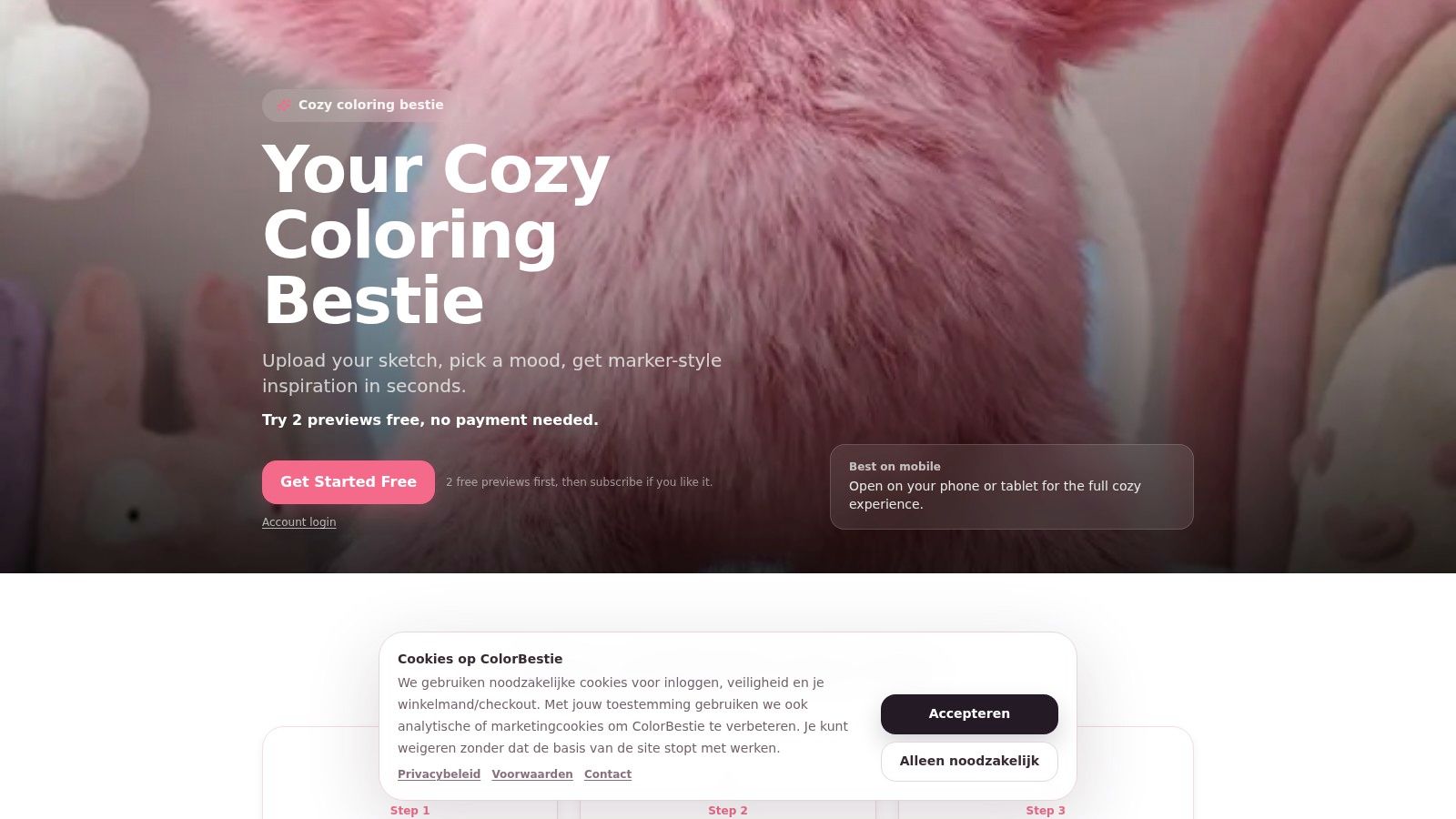
ColorBestie turns a black-and-white sketch into a marker-style color preview, which makes it easier to see how a piece will read before you commit ink. It also maps colors to popular marker systems, so the planning step doesn't stay trapped on the screen. The tool's palette generator is especially useful when you want a harmonious starting point instead of staring at a blank swatch sheet.
The workflow is simple. Upload a sketch, review the marker-style preview, then use the color guidance to translate that digital idea into a real marker palette. That bridge is helpful whether you're using Ohuhu, Copic, Prismacolor, or another alcohol-marker line, because the hard part is often not coloring, it's deciding confidently before you color.
Why this changes the drawing process
Most marker mistakes happen before the marker ever opens. Artists choose too many similar tones, miss a shadow family, or overbuy colors that don't work together on the page. A preview step forces the palette to behave like a real composition instead of a pile of individual pens.
That kind of prep also makes swatching more meaningful. When you already know the direction of the piece, swatching becomes a targeted check instead of random testing. You waste less ink, make fewer color guesses, and move into the actual artwork with more confidence.
Essential Techniques for Marker Mastery
Good markers still need good handling. Even the strongest alcohol marker setup can look muddy if the fill is rushed, the blend is forced, or the paper gets abused. The basics are simple, but they matter every single time you sit down to render.
The core habits that make a difference
Start with flat fills before you chase fancy gradients. If the base layer is patchy, every shadow on top will look more complicated than it really is. Use controlled overlap, keep your strokes moving in one direction when you can, and don't flood the area just because the marker is juicy.
Layering is where alcohol markers really earn their keep. Build depth gradually instead of trying to reach the final value in one pass. That gives you cleaner transitions and keeps the drawing from feeling overworked.
Practical rule: if a shadow needs three passes, give it three passes. Forcing one heavy pass usually makes the finish worse, not faster.
Care matters just as much as technique. Store markers horizontally when possible so ink distribution stays more even. Don't mash the nib into rough paper, and replace or refill parts when the marker starts to feel inconsistent rather than waiting until it's completely unusable. That's the difference between tools that last and tools that feel frustrating after a few sessions.
Frequently Asked Questions About Illustration Markers
What paper works best for alcohol markers
Use paper that can handle repeated layering without buckling or bleeding through too fast. Heavier marker paper is the safer choice for illustration because alcohol ink likes to travel, and thin paper punishes every extra pass. If your goal is clean fills and controlled gradients, paper choice matters almost as much as the marker brand.
Can I mix marker brands in one artwork
Yes, and many illustrators do. Mixing brands is often practical when you're working from a shared color idea instead of a single branded palette. The important part is to test how the inks behave together on your chosen paper, because some combinations will layer more smoothly than others.
Are expensive markers worth it for beginners
Not always. If you're still learning how marker ink moves, a value-focused set can teach you the basics without making every practice page feel precious. The expensive option becomes more sensible once you know you enjoy the medium and want a system you can maintain.
How should I swatch new markers
Swatch them on the same paper you plan to draw on, not just on a random card. Mark the cap, the body if needed, and the actual sample stroke so you can compare what the marker looks like in hand versus on paper. That habit saves a lot of confusion later, especially with colors that look similar at a glance.
For faster palette testing and color mapping, try ColorBestie and use it to preview marker-style color ideas before you buy or open a new set. It's a practical way to turn guesswork into a cleaner plan, especially if you're choosing between Copic, Ohuhu, Prismacolor, or another alcohol-marker setup.