You've painted a lovely blue sky, then reached the foreground and watched the watery color spread far beyond the shape you intended. The problem may not be your pigment or paper. Often, it's that the only brush nearby was a large round that couldn't release water with enough control.
Choosing brushes for water color becomes much easier when you stop treating every shape as essential. A small, well-chosen kit can handle most everyday watercolor work: one large wash or mop brush, one medium round, and one small round or detail brush. From there, hair, shape, size, ethics, and care each solve a different problem.
Why the Right Brush Matters More Than You Think
A watercolor brush is a small reservoir, a steering tool, and a mark-making instrument at the same time. Its hair controls how much water reaches the paper, its shape controls the edge and stroke, and its size determines how quickly you cover an area. The pigment matters, but the brush decides how that pigment behaves once it leaves the palette.
A large round can make broad marks, but it may not give you the flat edge needed for a clean horizon. A tiny detail brush may offer control, yet force you to reload during a sky wash. That interruption can create uneven bands, especially while the paper is still wet.
Start with three useful jobs
You don't need a drawer full of specialty tools to begin. A practical starter kit contains:
- Large wash or mop: Use it for first washes, skies, paper backgrounds, and generous wet-on-wet passages.
- Medium round: Use it for most shapes, mid-values, stems, petals, buildings, and controlled edges.
- Small round or detail brush: Use it for dark accents, fine lines, lettering, eyes, branches, and finishing marks.
This three-brush approach reflects guidance from Learn to Paint Watercolor's practical brush recommendations, which emphasizes versatility over collecting every available shape. Specialty brushes such as fans, daggers, and filberts can be enjoyable, but they're usually optional for a beginner.
Practical rule: Buy brushes for the marks you make repeatedly, not for the impressive number of shapes printed on a package.
Brushes also have a long history. One widely cited account traces animal-hair or bristle brushes bound to wooden handles to Egypt as early as 4000 BCE and China as early as 200 CE. By the 1850–1880 period in England, improved paper, collapsible paint tubes, and a wider range of brushes helped watercolor gain acceptance alongside oil painting, as described in Handprint's history of watercolor brushes.
The rest of your buying decision becomes calmer once you separate the jobs. First choose hair for water behavior, then shape for the mark, size for the area, and care for longevity.
Understanding Brush Hair Types
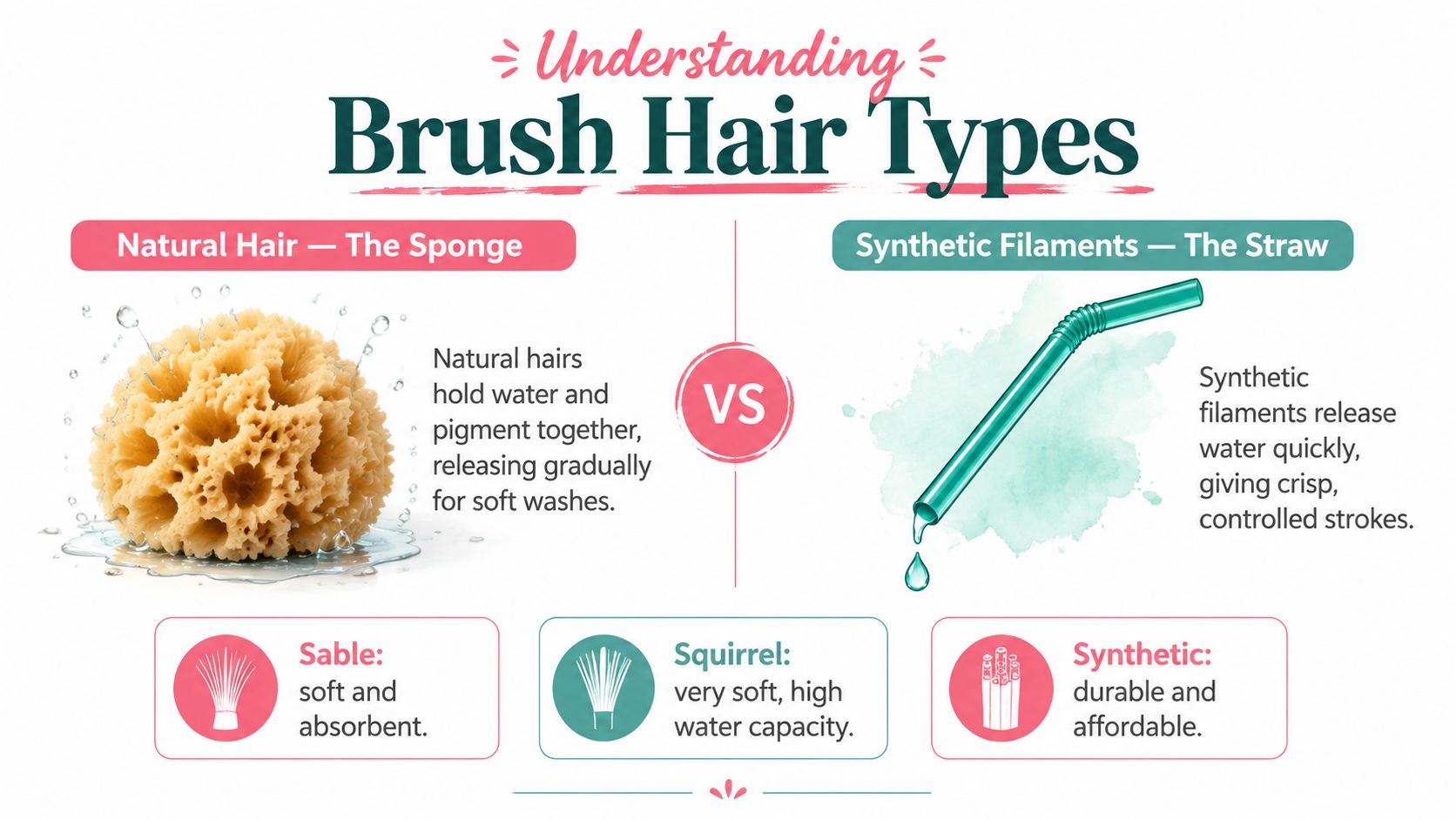
At the palette, hair type changes how paint arrives on paper. Natural hair works like a soft sponge, while synthetic filament behaves more like a bundle of small straws. Natural hair absorbs water and pigment into its porous surface, then releases the mixture gradually. Synthetic fibers tend to let liquid go more directly and spring back more readily under your hand.
The comparison predicts handling, not quality. Choose the behavior that suits the mark.
Natural hair and its strengths
Kolinsky sable remains a benchmark for professional pointed rounds. Its fine hairs combine absorbency with a responsive tip, so a well-made brush can carry a continuous line, taper smoothly, and return to its point as pressure changes. Other red sable brushes can offer a similar balance, although construction affects the exact feel.
Squirrel hair is very soft and holds plenty of water, which suits washes and gentle transitions. It feels less springy than sable. Goat and pony hair also work well in broad, soft brushes, where coverage and a mild release matter more than a sharp snap.
Absorbency has a practical advantage. A brush that carries more liquid requires fewer trips to the palette, lays down a more even wash, and gives you more time for wet-on-wet blending, as explained in Artists Network's watercolor brush guide.
Natural sable, especially kolinsky, still sets the benchmark when you need a pointed brush that carries a long line and responds delicately to pressure.
Synthetic fibers and their tradeoffs
Synthetic brushes use engineered filaments that imitate selected qualities of natural hair. They are often springier, durable, and consistent from stroke to stroke. They also avoid animal-based inputs. Their lower water capacity may make long washes less convenient, yet that same behavior helps place crisp marks without flooding a small area.
Modern synthetic fibers are more than inexpensive substitutes. Industry coverage describes interest in ethically sourced materials and synthetic fibers designed to improve durability and ergonomics, as outlined in watercolor brush market coverage from Data Insights Market.
Match the hair to the task. Natural hair suits fluid capacity and soft release. Synthetic hair suits spring, control, cruelty-free sourcing, and straightforward maintenance. A mixed collection can provide both responses, so one brush does not have to handle every job.
Brush Shapes and What Each One Does
Brush shape is easier to understand when each tool has one primary job. You're not choosing between dozens of mysterious objects. You're choosing the edge, line, texture, or wash you want to create.
A round is the general-purpose option. Its belly carries paint, while its tip handles detail. A pointed round narrows into a sharper tip for delicate lines, small leaves, and controlled accents.
A flat lays down broad rectangular marks and clean edges. A dedicated wash brush covers large areas efficiently, especially backgrounds and skies. A mop or quill has a soft, full belly that carries water for loose washes and blended passages.
Filberts have a rounded edge, useful for curved petals and soft organic shapes. Fans split into separate bristles that can suggest grass, foliage, hair, or dry texture. A dagger makes tapered strokes and angled marks, while a rigger liner creates long, thin lines for branches, wires, grasses, and signatures. A hake is a broad, soft brush for large washes when precision isn't the main concern.
| Brush Shape | Best Technique | Starter Kit Role |
|---|---|---|
| Round or pointed round | Lines, details, varied strokes | Medium or small round |
| Flat | Crisp edges and broad rectangular marks | Optional, unless you paint hard-edged shapes |
| Wash | Skies, backgrounds, first layers | Large wash brush |
| Mop or quill | Wet-on-wet blending and soft coverage | Large mop |
| Filbert | Petals and rounded organic forms | Optional |
| Fan | Foliage and dry texture | Specialty |
| Dagger | Tapered leaves and angled marks | Specialty |
| Rigger liner | Long fine lines and signatures | Optional detail brush |
| Hake | Very broad, soft washes | Optional large brush |
The key is to match a brush to a technique, not to collect a shape because it exists. If you're planning a limited palette for a painting, a palette generator can help you think about the colors and marks you'll use before you add another brush to your basket.
How Sizes, Numbers, and Brands Work Together
Brush numbers are best understood as a rough scale. In general, a higher number means a larger brush head, while a lower number means a smaller one. The system usually runs from size 000 through size 20 or larger, although manufacturers don't always make every size.
You can hold the system in your head as three working groups:
| Size Range | Tier | Best For |
|---|---|---|
| 000–2 | Small | Details, lettering, fine lines, tiny accents |
| 4–8 | Medium | General painting, mid-sized shapes, everyday work |
| 10–20+ | Large | Broad washes, skies, wet-on-wet backgrounds |
A size 4 or 6 round often feels like the natural center of a beginner's kit. It carries enough paint for ordinary shapes while still giving you a usable point. A small round handles the final accents, and a large wash or mop prevents you from trying to fill a whole sky with a brush meant for leaves.
Why the number isn't universal
A size 6 from one brand may not match a size 6 from another. Manufacturers can differ in hair length, belly fullness, ferrule design, and the way they measure the brush. Even two brushes with the same printed number may make different marks.
If possible, test the brush in person. Look for a clean point, a secure ferrule, and a belly that suits the amount of water you like to use. If you shop online, compare photographs of the actual brush head rather than relying only on the number.
Your three-brush kit doesn't need three matching numbers. Think in jobs: one large, one medium, and one small. That range gives you flexibility without turning the supply cupboard into another creative problem.
Choosing by Budget, Skill Level, and Purpose
You sit down to paint a small botanical study, but the brush in your hand holds too much water for each leaf. Someone painting loose skies would face the opposite problem. The right purchase depends on how you paint, what you can spend, and what you want the brush to do, not on owning the largest set.
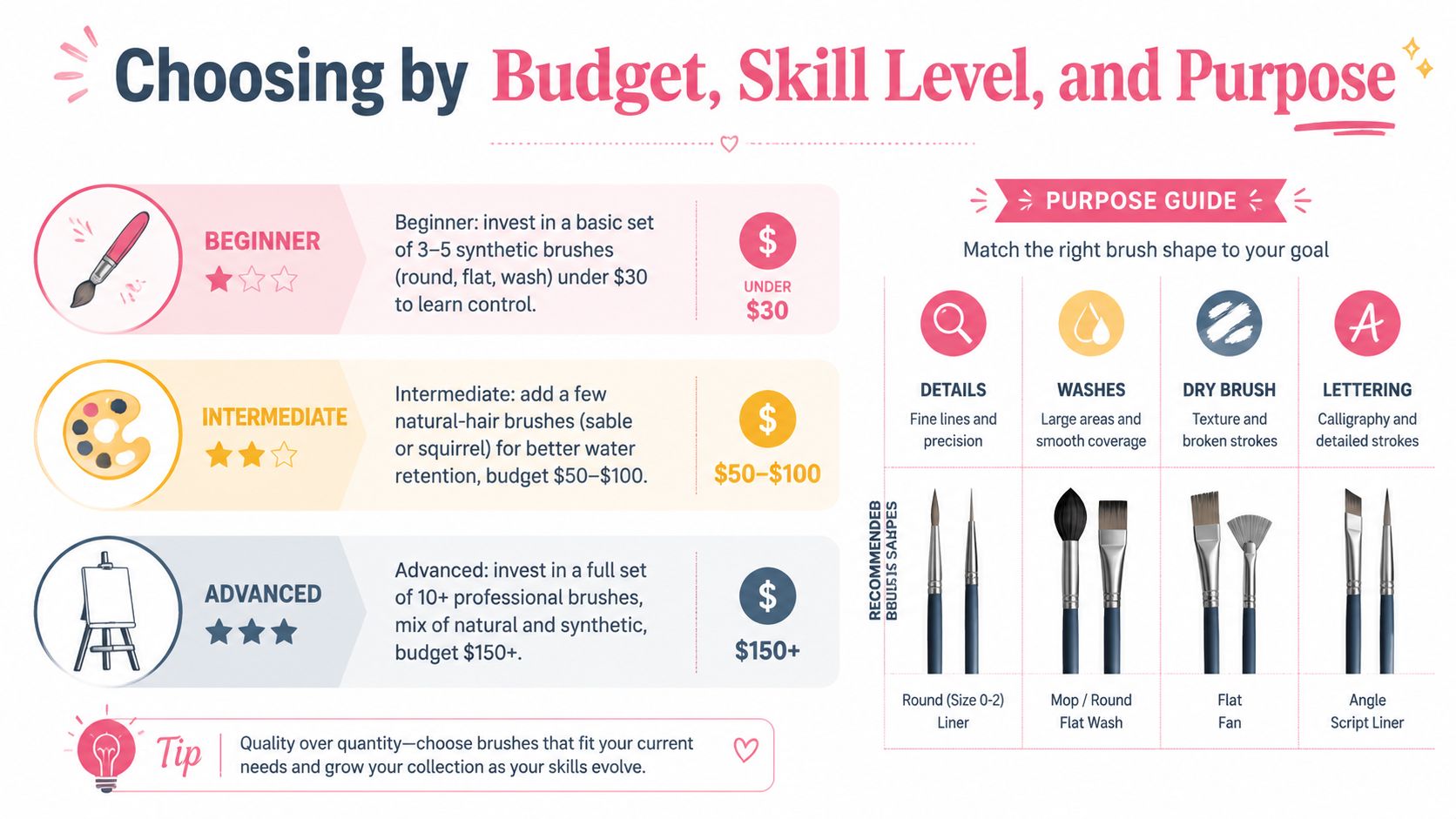
Start with a minimum viable kit of three reliable synthetic brushes: a medium round, a larger round or wash brush, and a small round. Together, they cover broad passages, ordinary shapes, and fine accents. They also let beginners practise pressure, water control, and stroke direction without adding natural-hair maintenance to the first lesson. Affordable synthetics have improved considerably and can serve learners very well.
A simple buying framework
- Beginning with general practice: Choose the three-brush kit above. Look for a comfortable handle and a point that returns after use.
- Developing a specific technique: Add a natural-hair mop for soft washes or a rigger for long lines. Add the brush only when your paintings show why its behavior would help.
- Building a personal studio kit: Mix natural and synthetic fibers according to the job. Absorbent hair supports long fluid passages, while springy synthetics provide crisp control and a cruelty-free option.
These are separate decisions. First choose the marks you need, then consider the fibers and finally the budget. A beginner does not need to solve every brush question at once.
Ethics can guide the purchase without creating guilt. Synthetic brushes avoid animal hair, and some manufacturers are working toward more sustainable handles and packaging. Their use also reflects continued development in brush materials, rather than treating synthetic fiber as merely a lower-tier replacement for animal hair.
Longevity matters more than a low shelf price. A well-made brush that keeps its point and ferrule can remain useful for a long time, while a poorly made brush may lose its shape quickly. Premium sable or squirrel is not required for beautiful paintings. Buy the performance you need now, care for it consistently, and upgrade when you can name the limitation you are trying to solve.
For artists comparing tools across media, a marker comparison guide can clarify which tools suit fluid washes, controlled lines, or layered color. Choose according to the mark and medium, not the size of the set.
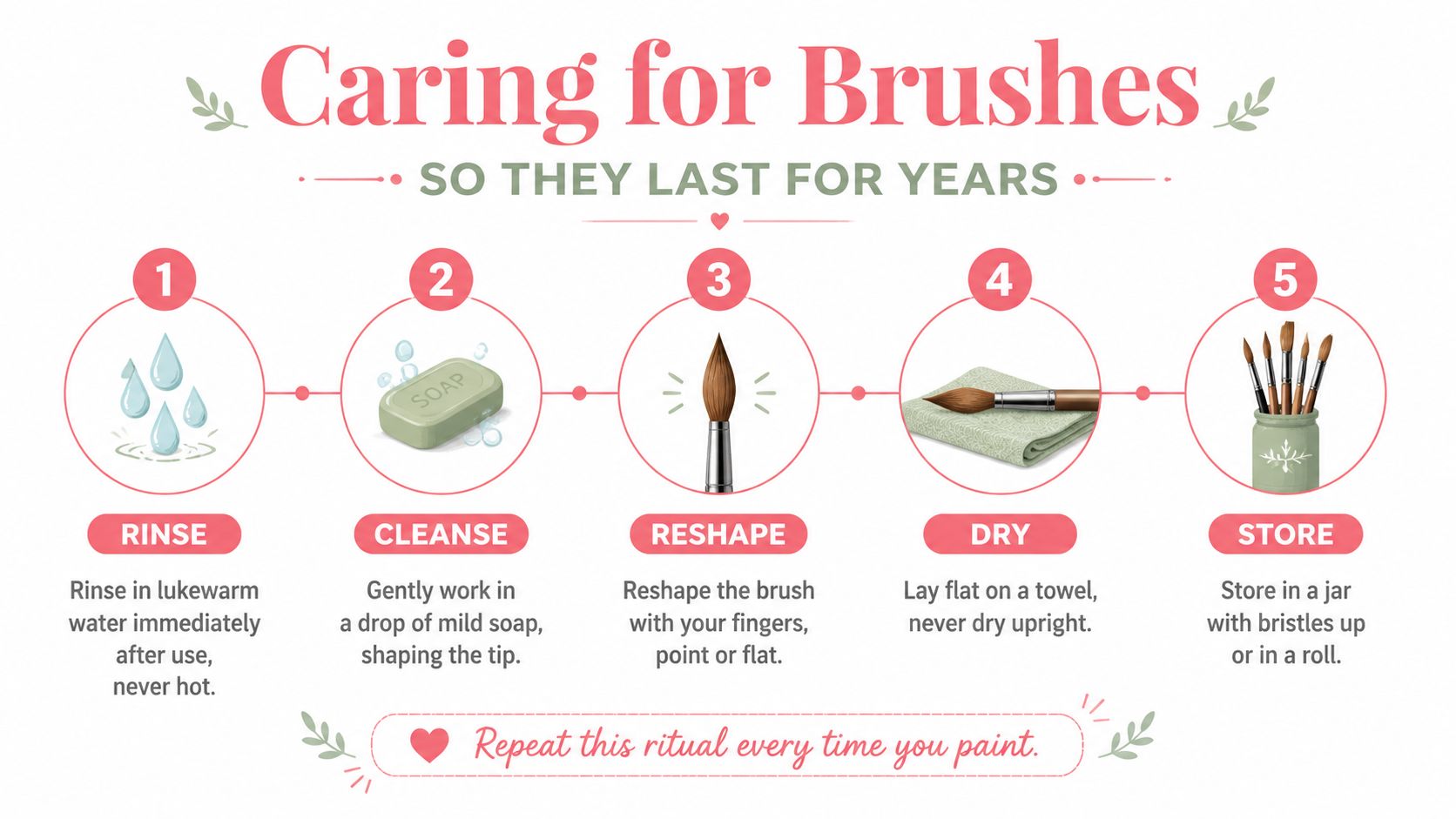
Caring for Brushes So They Last for Years
Brush care doesn't need to become a ceremony. Treat it as a short closing routine after each painting session, and your brushes will be easier to control the next time you sit down.
First, rinse immediately. Use cool or lukewarm water to remove watercolor before it dries in the ferrule. Hot water can loosen adhesive and damage the handle or brush construction.
Second, clean gently. If pigment remains near the ferrule, work in a small amount of mild soap or brush cleaner. Avoid harsh detergents, which can strip natural oils and leave fibers brittle.
Third, reshape while damp. Use your fingertips to restore the point on a round, the edge on a flat, or the soft spread of a mop. Don't twist the hairs aggressively. A gentle pinch and smooth motion is enough.
Fourth, dry with care. Lay the brush flat on a clean towel, or hang it with the tip pointing downward. This keeps excess water from sitting inside the ferrule, where it can contribute to rust, swelling, or cracking.
Fifth, store it with air around it. A ventilated brush roll protects the hairs during travel. An upright container works too, provided the brushes aren't packed so tightly that their tips bend against one another.
A brush should never spend the night standing in water.
Don't soak brushes, leave them bristle-down in a jar, or use delicate watercolor brushes for glue, masking fluid, acrylic, or other materials that may dry differently. Even a modest synthetic brush can become a dependable studio companion when you rinse it promptly, reshape it, and let it dry properly.
Quick Recommendations and Common Questions
If you're standing in an art shop and want a direct answer, choose according to the kind of work you do most often.
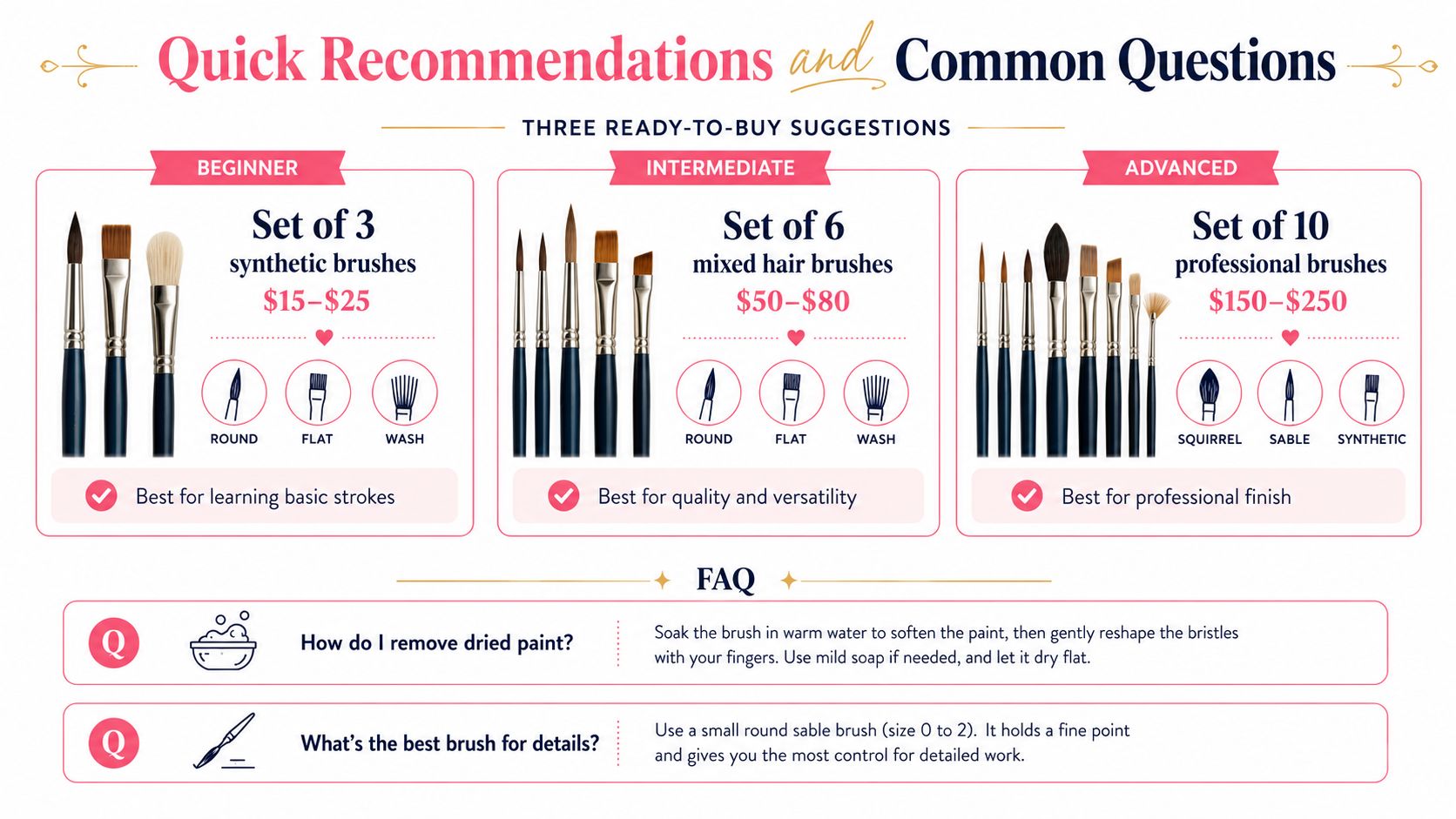
- For a new painter: Buy three synthetic brushes, a large wash or mop, a medium round, and a small round. This covers first washes, general shapes, and details without crowding your desk.
- For a developing painter: Keep the core three and add a natural-hair mop or a rigger when you notice a specific need for softer water release or longer lines.
- For an experienced painter: Build a mixed collection around your personal techniques. You might favor kolinsky or another sable for pointed rounds, squirrel for soft washes, and synthetics for springy texture and controlled edges.
The quick brush recommendations and FAQ visual guide can serve as a compact reminder while you compare sets.
Do synthetic brushes rival natural kolinsky?
They can perform extremely well, but they don't behave identically. Kolinsky sable generally offers outstanding liquid capacity, a fine point, and a soft, responsive release. Synthetic brushes often provide more spring, consistent control, easier cleaning, and a cruelty-free choice. For many learners and working artists, those advantages make synthetic a deliberate preference rather than a compromise.
How often should I replace a worn brush?
Replace a brush when its shape prevents you from making the marks you need. A bent point, split tip, loose ferrule, or permanently splayed head tells you the brush has reached the end of its useful role. You may still keep it for texture or rough washes, but don't ask it to make precise lines.
Can one round brush handle a whole painting?
Yes, especially a medium round with a useful belly and point. It can create broad strokes when loaded, narrow lines when held lightly, and details with its tip. One round won't be as efficient as a three-brush kit, though. A large wash brush makes backgrounds easier, while a small round saves time on fine work.
You don't have to make the perfect purchase today. Start with three clear jobs, notice how the brushes behave in your hand, and let your collection grow only when a technique asks for something new.
ColorBestie helps you plan color ideas from sketches with marker-style previews, theme worlds, palette tools, and marker comparisons. Visit ColorBestie to test harmonious color directions before you commit them to paper.