You're halfway through an illustration when the greens stop cooperating. Four tins are open, your reference photo is beside the paper, and the pencil that looked perfect in the swatch book turns muddy under the afternoon light. One green drags across the tooth, another crumbles at the point, and a third looks fine until an alcohol marker passes nearby and leaves a blotchy halo.
That's the practical reason coloring pencil brands matter. The label on the tin isn't a prestige badge. It reflects decisions about core formulation, pigment concentration, binder, manufacturing tolerances, and lightfastness. The right set should suit the way you work, whether you're relaxing with an adult coloring book, building marker layers, or making an illustration intended for display.
The global category is substantial, with the colored pencil market estimated at about USD 2.14 billion in 2024 and projected to reach roughly USD 4.35 billion by 2034, a projected compound annual growth rate of about 6.8% from 2025 to 2034, according to Cognitive Market Research's colored pencil market coverage. You've got plenty of choice. You don't need every famous brand, though. You need the one whose core behaves properly on your paper.
Why the Brand on Your Pencil Tin Matters
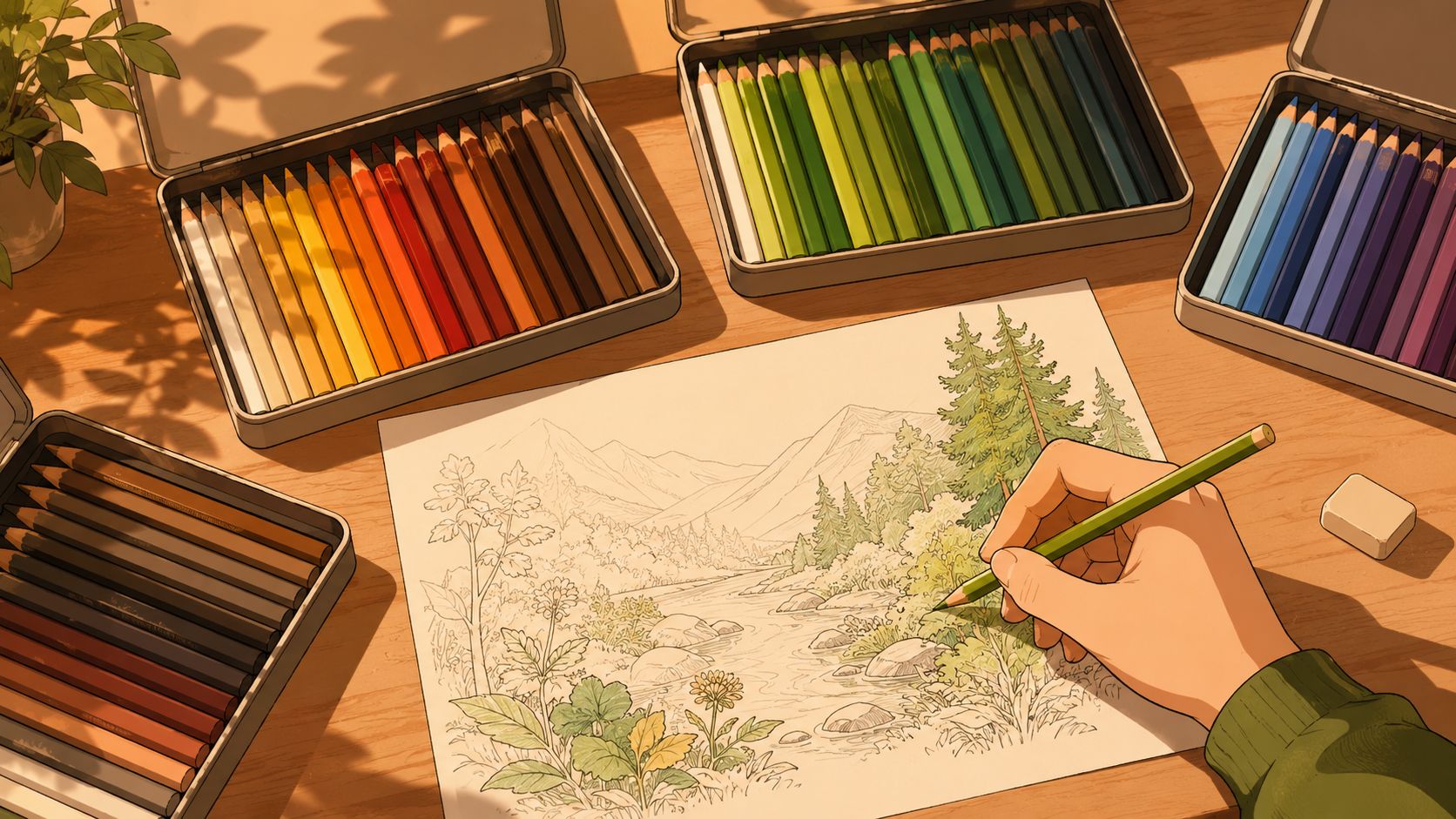
Two pencils labeled with a similar green can behave nothing alike. One may cover paper with a dense, even stroke. Another may leave the tooth exposed, demand repeated passes, and turn scratchy before the area is complete. The difference lies in core formulation and quality control, not the color number printed on the barrel.
Your use case exposes those differences quickly. Under an alcohol-marker base, a harder, controlled pencil can add crisp detail without disturbing the ink. A softer, wax-heavier core may resist fresh marker color, smear at the edges, or produce a cloudy transition. Pressure response and binder behavior decide whether the pencil sharpens the marker work or muddies it.
Match the tin to the job
A pencil brand is a tool manufacturer making a particular compromise. A soft core delivers quick saturation and smooth blending, but its point wears down fast. A firm core stays sharp for eyelashes, comic hatching, and architectural edges, yet takes longer to fill a broad background.
Choose by technique:
- How do you build color? Heavy layering needs a core that accepts repeated, light passes without becoming slick.
- Do you use alcohol markers underneath? Select a pencil that adds detail without pushing marker ink across the surface.
- Will the artwork be displayed? Published lightfastness information carries more weight than an attractive tin.
- Do you color for relaxation? Comfortable laydown and easy blending matter more than archival performance.
Shop-floor rule: Buy for the paper and technique you use most, not for the brand with the loudest reputation.
Brands including Derwent, Faber-Castell, Cretacolor, Prismacolor, Koh-I-Noor, Caran d'Ache, Mitsubishi Pencil, Staedtler, Spectrum Noir, Holbein, and Crayola appear throughout the global category, as noted in Cognitive Market Research's industry overview. That list identifies familiar options. It does not decide which core belongs in your drawer. For marker layering, prioritize controlled adhesion. For adult coloring, favor comfortable coverage. For archival illustration, verify lightfastness before buying the full set.
What Really Sets Coloring Pencil Brands Apart
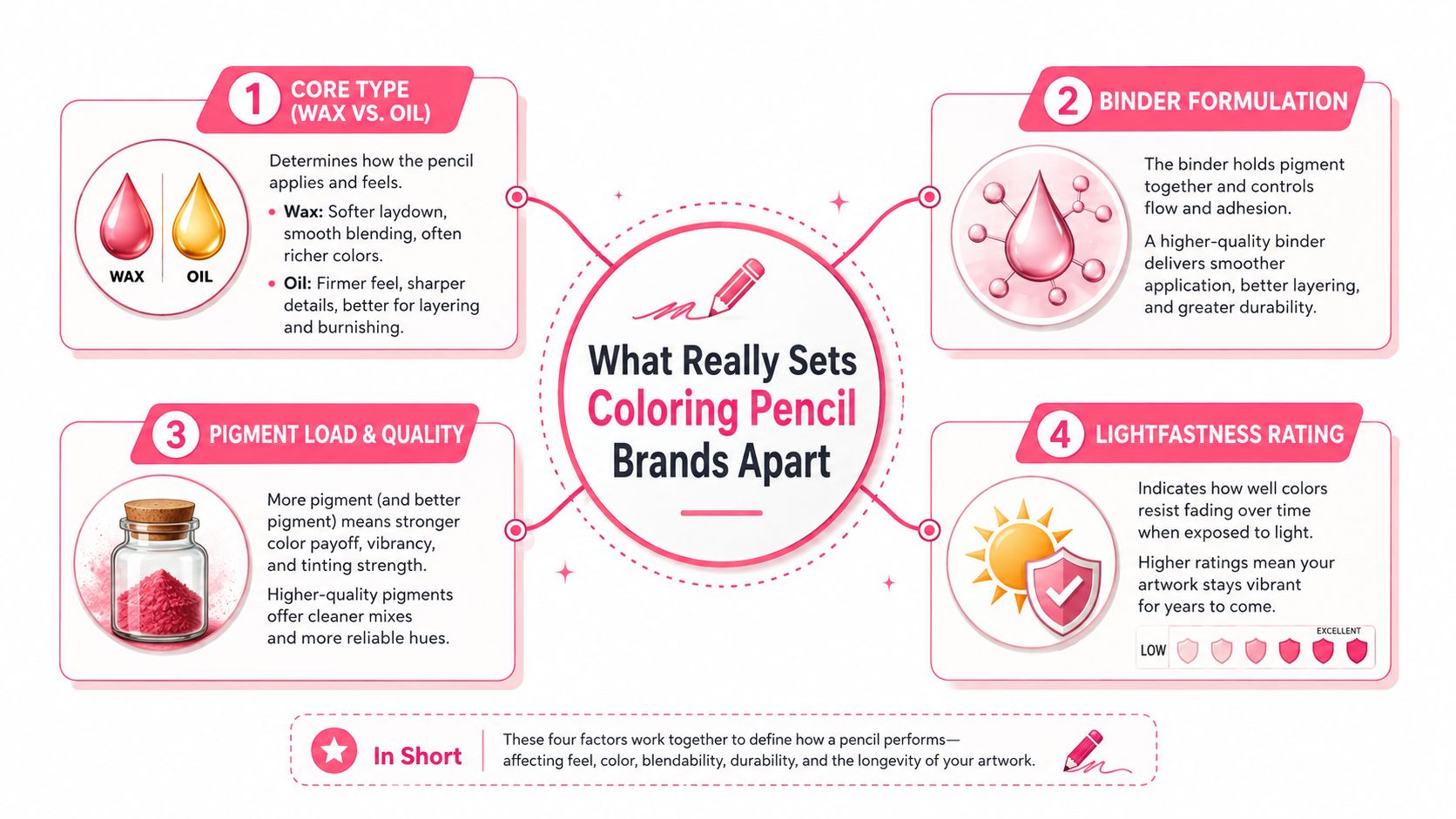
You can judge most coloring pencil brands by four working characteristics. You don't need a laboratory background. You need to understand what each characteristic changes on the page.
Core type controls the feel
Wax-based cores usually feel creamy and put down color quickly. They're friendly for broad fills, soft gradients, and relaxed coloring because the pencil seems to glide rather than scrape. Their weakness appears when you keep layering heavily. The surface can become slick, and additional pigment may stop adhering evenly.
Oil-based cores generally feel firmer and hold a point for longer. They're useful for fine lines, hair strands, comic details, and gradual translucent layering. They may need more pressure before they look fully opaque, but that slower build gives experienced artists better control over modeling and edges.
Technical comparisons from Step by Step Art's colored pencil brand guide describe the same tradeoff. Softer wax cores tend to deliver dense pigment quickly and cover paper tooth more effectively, while firmer oil cores support sharper points and tighter line work.
Binder is the pencil's structural glue
The binder holds pigment together inside the core. Think of flour holding a cake mixture together. Change the balance, and the finished cake can be soft, crumbly, or firm. In a pencil, binder choices affect breakage, drag, blending, and how the core responds when another medium touches the surface.
A weak or overly soft core may crumble when you press over a marker layer. A well-balanced core can leave a clean line without shedding crumbs across the page. You'll notice this most around small details, where a broken point can turn a crisp eyelash or leaf vein into a blunt mark.
Pigment load affects coverage
Pigment load means how much actual coloring material is packed into the core. More pigment usually means stronger color with fewer passes, although the exact experience still depends on the binder and the pigment itself. Student ranges often feel pleasant for casual work, but they may need more layering to reach the depth an artist-grade pencil produces more readily.
Don't judge pigment load from a product photograph. Look for swatches made on the type of paper you use, and check whether the maker publishes meaningful technical information. A vivid casing doesn't guarantee a vivid stroke.
Lightfastness protects finished work
Lightfastness describes how well a color resists fading under light. It's the difference between a drawing that remains dependable on a wall and one that slowly changes after prolonged exposure to ultraviolet light.
ASTM D6901 is the key industry standard for artist colored pencils. Products conforming to that standard should disclose the brand name, color index, lightfastness, pencil type, manufacturer, toxicity, and conformance information on the label, according to the ASTM D6901 standard page. If a brand makes archival promises but gives you no usable rating system, I'd treat that promise cautiously.
The Top Coloring Pencil Brands Worth Knowing
Choose by the job, not by prestige. A marker artist needs a firm pencil that keeps its point, an adult colorist usually wants quick creamy coverage, and an illustrator preparing work for display needs documented permanence.
| Brand | Core Type | Pigment Load | Lightfastness | Best For | Weakness |
|---|---|---|---|---|---|
| Faber-Castell Polychromos | Oil-based | Artist-grade, dense and controlled | Published individual ratings | Marker layering, illustration, detail | Firmer feel can be slow for large fills |
| Prismacolor Premier | Wax-based | Artist-grade, rich and creamy | Ratings vary by color, check the pencil | Adult coloring, portraits, saturated coverage | Softer points need careful sharpening |
| Caran d'Ache Luminance | Wax-based, soft artist core | Premium artist-grade | Strong published lightfastness profile | Archival illustration and commissions | Expensive, and very soft for some detail work |
| Derwent Lightfast | Oil-based | Artist-grade | Designed around lightfast performance | Permanent color work and broad palettes | Firm handling won't suit everyone |
| Faber-Castell Goldfaber | Wax-based | Student-to-intermediate positioning | Check the product labeling | Practice, sketching, general coloring | Less suited to serious archival work |
| Crayola | Wax-based | Student grade | Not the main selling point | Children's work and inexpensive practice | Marker interaction and layering are limited |
| Arteza Premium | Wax-based | Accessible artist-style range | Check individual product details | Casual coloring and broad color exploration | Consistency and archival documentation can be less convincing |
Faber-Castell Polychromos is the strongest all-round pick for artists who need control. Its oil-based core holds a useful point and layers cleanly over many marker foundations, so it handles outlines, texture, and small corrections well. The firmer feel slows down broad fills, but that trade-off is worthwhile for precise work and marker layering.
Prismacolor Premier is the better choice for fast, saturated coloring. Its soft wax core spreads rich color quickly, which makes adult coloring books and portrait passages more comfortable. Buy a reliable sharpener and use a light hand. The point wears down quickly under pressure, and a polished waxy surface can make later layers less predictable.
For display work and commissions, choose Caran d'Ache Luminance. Its strong lightfastness profile suits archival illustration, while the soft core lays down dense finishing color. The high price limits its appeal, and its softness can frustrate anyone who needs needle-sharp detail.
Derwent Lightfast fits permanent color work when you prefer controlled handling over instant creaminess. It offers a firm, deliberate feel and broad palette potential. Choose it for illustrations that need dependable color behavior, not for quick coloring-book coverage.
Faber-Castell Goldfaber is a sensible practice and study set, especially as a move beyond basic student pencils. Crayola remains appropriate for children, casual experiments, and inexpensive practice, but its wax behavior limits smooth marker interaction and repeated layering. Arteza Premium gives hobbyists broader color exploration at an accessible level. I would still inspect individual product documentation before using it for work that must remain archival.
For visual palette planning, ColorBestie's theme preview tool can help compare color directions before you commit to a set. Use it to narrow the palette, then swatch the actual pencils on your paper. The core, pressure, and surface decide the final mark, not the appearance of the tin.
Pairing Coloring Pencils with Alcohol Markers
Alcohol markers lay down wet, fast-moving ink. Colored pencils add a drier layer of controlled pigment. The pairing works when the pencil's surface behavior lets the marker move without skidding or creating uneven pools.
Wax-heavy pencils can resist alcohol ink, especially when you apply them first with firm pressure. Crayola and lower-tier student pencils are the combinations I'd avoid underneath Copic, Ohuhu, or Arteza markers when you need a smooth foundation. The marker may feather around the wax, skip across a polished patch, or leave a muddy edge instead of blending naturally.
Oil-based and better-formulated wax or oil-hybrid pencils are more dependable. Faber-Castell Polychromos is my first choice for marker layering because its firmer core gives you clean accents after the marker has dried. Caran d'Ache Luminance works when you want a softer finishing layer and strong permanence. Prismacolor Premier can be beautiful over marker, but use less pressure than you think because its soft wax core can quickly become slippery.
Use the right order
For most marker-heavy work, lay down the alcohol marker first. Let it dry completely, then add pencil in light layers. This keeps the pencil from interfering with the marker's movement and lets you use the pencil where markers struggle, such as tiny highlights, eyelashes, fur texture, fabric seams, and soft edge corrections.
A few habits prevent avoidable mess:
- Test the exact combination. Make a marker swatch, let it dry, and apply the pencil on the same paper before touching the illustration.
- Lower your pressure. Heavy pencil pressure polishes the surface and makes later layers less cooperative.
- Reserve soft pencils for accents. Use them to enrich shadows or soften transitions rather than covering an entire marker foundation.
- Protect the page. Put scrap paper beneath the work to catch bleed-through and avoid transferring wet ink to the next sheet.
Paper changes the result as much as the brand. Marker paper generally supports cleaner ink movement, while textured colored-pencil paper gives a pencil more tooth but may show uneven marker coverage. A marker comparison tool such as ColorBestie's marker comparison can help you compare marker systems before pairing them with a pencil set.
The included demonstration is useful for seeing how a marker and pencil workflow can be staged in practice.
Choosing the Right Brand for Your Use Case
Choose a coloring pencil by the work it must do, not by the prestige of the tin. A soft pencil that feels wonderful for adult coloring may smear over alcohol-marker ink, while a harder, more controlled core may suit illustration but feel slow across a large page. Match the brand to your pressure, paper, layering method, and desired finish.
For adult coloring and relaxed coverage
Buy Prismacolor Premier when creamy laydown matters most. It covers broad areas quickly, blends readily, and gives flowers, ornaments, animals, and fantasy scenes the saturated finish many adult colorists prefer. Its softness is less useful for precise marker-detail work, so treat it as a coverage-first choice.
Arteza Premium is a sensible alternative for broad color exploration without moving to the premium end of the market. Start with a small or mid-size set while you learn your preferred palette. A large tin adds options, but near-duplicate colors can distract you from learning how a compact group layers on your paper.
For client work and portfolio illustration
Choose Faber-Castell Polychromos for dependable control, fine detail, and a balanced feel over a dry marker base. Choose Caran d'Ache Luminance when framed presentation and archival permanence matter more than cost or point retention. Both suit illustration, but the right choice still depends on the actual paper and marker surface you use.
Lightfastness information matters for commissions. Review the manufacturer's stated ratings and test the exact colors planned for the piece. Keep the product information with your project notes so the materials remain identifiable after completion.
For marker-heavy layering
Pick Derwent Coloursoft when you want a softer pencil for rich finishing color over dry alcohol-marker layers. Pick Bruynzeel Design when you want more control for line work and small corrections. Test either brand on your regular marker paper before buying a large set. The best match is the pencil that grips the dried ink cleanly without skipping, excessive waxiness, or unwanted smearing.
| Use Case | Recommended Brand | Set Size | Price Tier |
|---|---|---|---|
| Adult coloring and soft coverage | Prismacolor Premier | Small or mid-size set | Mid to premium |
| Casual color exploration | Arteza Premium | Small or broad set | Accessible to mid |
| Client and portfolio illustration | Faber-Castell Polychromos | Small professional set | Premium |
| Archival commissions | Caran d'Ache Luminance | Curated professional set | Premium |
| Marker-heavy finishing | Derwent Coloursoft | Curated working set | Mid to premium |
| Controlled marker detail | Bruynzeel Design | Curated working set | Mid |
Plan the palette before buying a full range or starting a commission with ColorBestie's palette generator for exploring harmonious color directions. It can suggest color relationships, but it cannot predict whether a pencil feels too soft, too firm, or too slippery in your hand. Make the final decision from a swatch card using your usual paper and marker system.
Sustainability Claims That Hold Up and Greenwashing to Skip
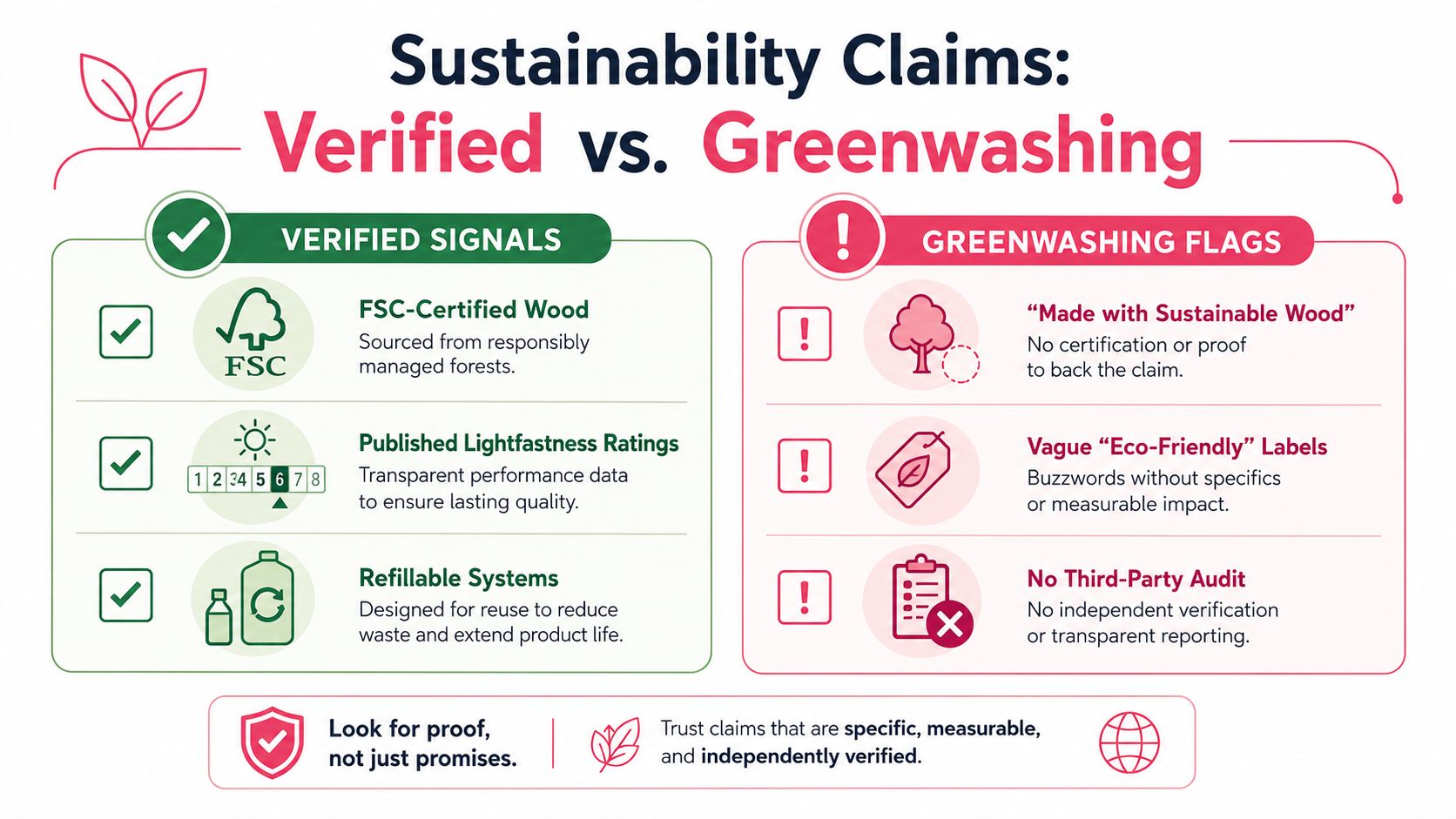
Colored pencil sustainability claims deserve the same scrutiny as lightfastness claims. A green leaf printed on a tin doesn't tell you where the wood came from, whether the packaging claim has third-party support, or whether the product's core formulation has been assessed responsibly.
The strongest signals are specific and checkable. Look for FSC-certified wood, published lightfastness ratings, refill or open-stock availability, and supply-chain disclosures that name the relevant certification or standard. Industry tracking identifies sustainability as a major category driver, with eco-conscious materials scoring 92, biodegradable packaging showing 33% adoption in one market-tracking report, and 44% of manufacturers shifting toward FSC-certified wood materials, according to Simporter's colored pencil trends report. Those figures describe market-tracking findings, not proof that every brand using green language has earned it.
Check the evidence, not the adjective
Useful signals include:
- Named certification: An FSC claim should identify the certification rather than just say “sustainable wood.”
- Published technical ratings: Lightfastness information gives you a performance record you can evaluate, not just an environmental slogan.
- Open-stock availability: Replacing individual colors can reduce the need to discard an otherwise useful set.
- Clear packaging details: A specific material description is more useful than a vague biodegradable promise.
Greenwashing warnings include:
- Unqualified eco language: “Eco-friendly” means little without a standard, certification, or explanation.
- Natural claims without composition details: Natural doesn't automatically mean durable, non-toxic, or environmentally preferable.
- Packaging-only storytelling: A reduced package can still surround a product with unclear sourcing and no meaningful documentation.
- Anonymous marketplace branding: Amazon-only labels with no accessible manufacturer information deserve extra skepticism.
Faber-Castell and Caran d'Ache are worth investigating when you want concrete information about certification, refill systems, and artist-grade positioning. Don't assume a famous name settles every environmental question, though. Read the product page, look for certification details, and separate a verifiable material claim from attractive packaging copy.
Your Shortlist and Quick Answers
The shortlist is simple once you stop treating coloring pencil brands as a single prestige ladder.
| Brand | Best For | Core Type | Budget Tier |
|---|---|---|---|
| Faber-Castell Polychromos | Illustrators and marker layering | Oil-based | Premium |
| Caran d'Ache Luminance | Archival portraits and fine art | Soft wax-based | Premium |
| Prismacolor Premier | Hobbyists and saturated coverage | Wax-based | Mid to premium |
| Derwent Lightfast | Permanent color work with controlled handling | Oil-based | Premium |
| Arteza Premium | Accessible hobby exploration | Wax-based | Accessible to mid |
| Marco Raffine | Hobbyists seeking a soft, affordable core | Wax-based | Accessible |
Is a 24-pencil set enough to start? Yes. A compact set is enough to learn pressure, layering, and color mixing. Add open-stock colors only after you know which gaps keep interrupting your work.
How long does a quality pencil last? There isn't one honest answer. It depends on paper tooth, sharpening habits, pressure, and how much area you cover. A soft pencil used for broad backgrounds disappears faster than a firm pencil used for detail.
Can children use artist-grade pencils? They can, provided the set is suitable for the child's age and supervised where appropriate. Artist-grade cores may be softer, more breakable, and more expensive, so they're not automatically the sensible choice for classroom use.
Should you buy open stock or a tin? Buy a tin when you're building a new palette and want a coordinated range. Buy open stock when you already know your favorite colors or need replacements. Open stock also makes sustainability more practical because you can replace the one exhausted pencil instead of buying a duplicate collection.
If you want one oil-based set for illustration, choose Polychromos. If you want archival portrait work, choose Luminance. If you want relaxing, creamy coverage, choose Prismacolor Premier. For marker-heavy work, test a controlled oil-based pencil first, then add a softer pencil only where your finishing style needs it.
ColorBestie helps you preview marker-friendly palettes, compare marker brands, and turn reference images into color inspiration before you touch paper. Visit ColorBestie to test a palette direction and make your next pencil and marker pairing easier to plan.