Your brain might feel loud right now. You finished work, answered too many messages, made too many little decisions, and now even choosing a single marker sounds like one task too many.
That's exactly where stress relief coloring can help. Not as a test of creativity, and not as a project you need to finish beautifully. Just as a small, steady way to give your mind one gentle thing to do.
I use coloring this way often. Some evenings I want soft blues and easy leaf shapes. Other days I need a page with big spaces and almost no decisions at all. That difference matters more than most guides admit. A lot of advice about adult coloring assumes any page will calm you down. In practice, some pages soothe, and some make beginners tense up.
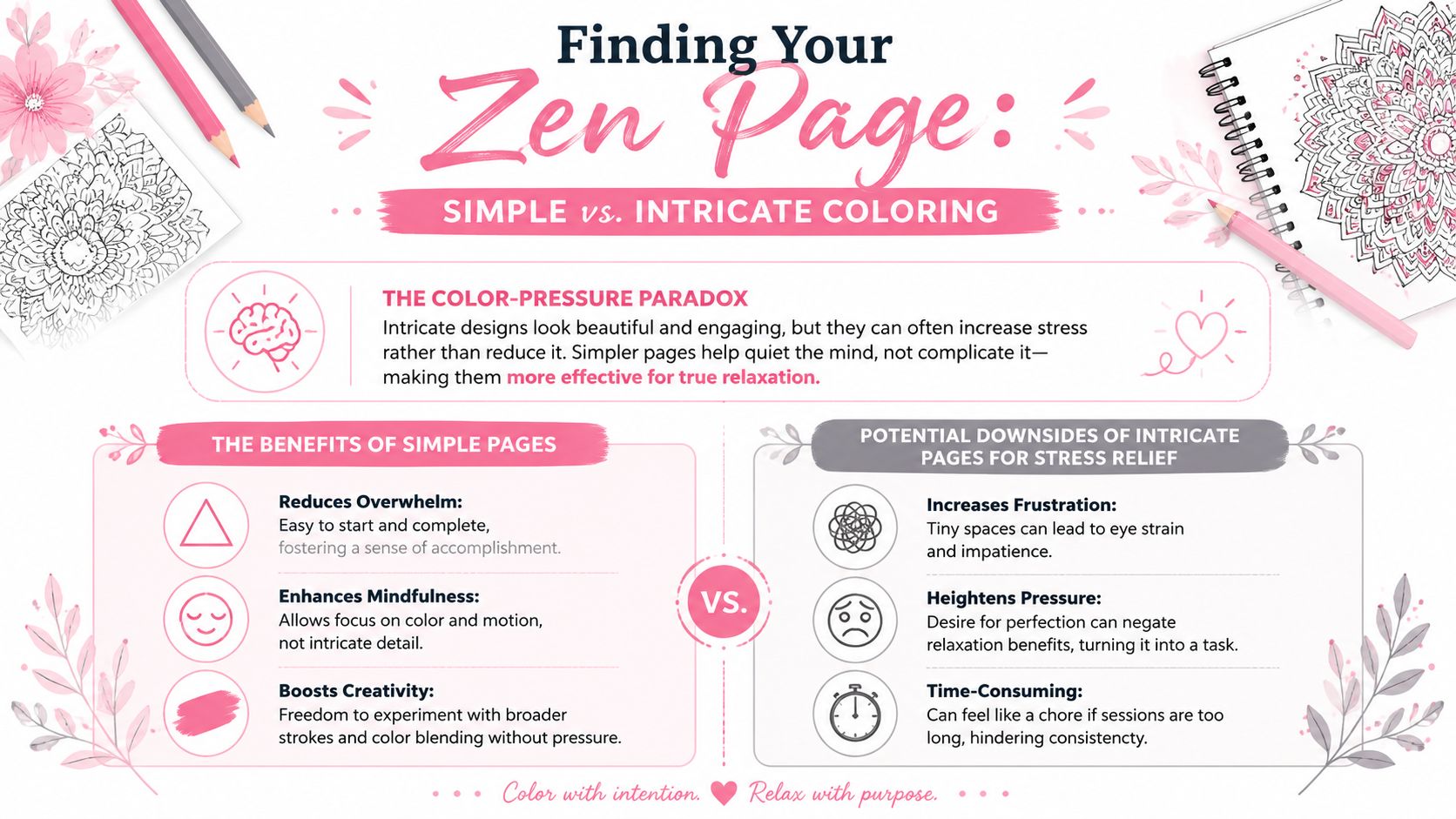
That's the Color-Pressure Paradox. The more intricate the page feels, the more pressure some people feel to stay inside every line, choose the “right” colors, and make the page look impressive. Instead of calming your nervous system, the session starts to feel like performance.
A better approach is simpler. Choose a page that feels easy to enter. Limit your tools. Color for comfort, not applause. Let the page hold your attention without demanding perfection.
From Chaos to Calm with Just a Page and Pen
A lot of people come to coloring at the end of a draining day. You sit down meaning to relax, open a book, and then freeze. The mandala looks beautiful but tiny. The floral page has dozens of little petals. Your marker case is full. Suddenly the calming hobby feels weirdly demanding.
That moment doesn't mean you're bad at coloring. It usually means the setup is asking too much from a tired mind.
I've learned to treat stress relief coloring less like art time and more like settling into a chair with a warm drink. The point isn't to produce something frame-worthy. The point is to lower the volume in your head. When I remember that, I stop reaching for the most detailed page in the book and start choosing what feels breathable.
Coloring works best for stress when the page feels like an invitation, not an exam.
There's also good reason to keep the process short and focused. A randomized controlled trial found that a single 20-minute session of mandala coloring significantly reduced self-induced anxiety, with an effect size above medium. Participants also reported feeling more “calmed down,” “safe,” and “at ease” immediately after the activity, as described in this mandala coloring anxiety trial.
That's encouraging because it means you don't need a whole afternoon, expensive supplies, or advanced shading skills. You need a page, a few colors, and a little room to breathe.
Make coloring easier to begin
When stress is high, these choices usually work better than ambitious ones:
- Pick larger shapes: Leaves, clouds, simple florals, cozy rooms, and broad geometric spaces are easier to enter than dense micro-patterns.
- Let unfinished be enough: You don't have to complete a page for the session to “count.”
- Use familiar tools: If your Ohuhu set feels easier than digging out every Copic refill and swatch card, use the easier option.
A calm coloring routine starts before the first stroke. It starts with removing pressure.
Preparing Your Calm Coloring Sanctuary
Make the space easy to return to
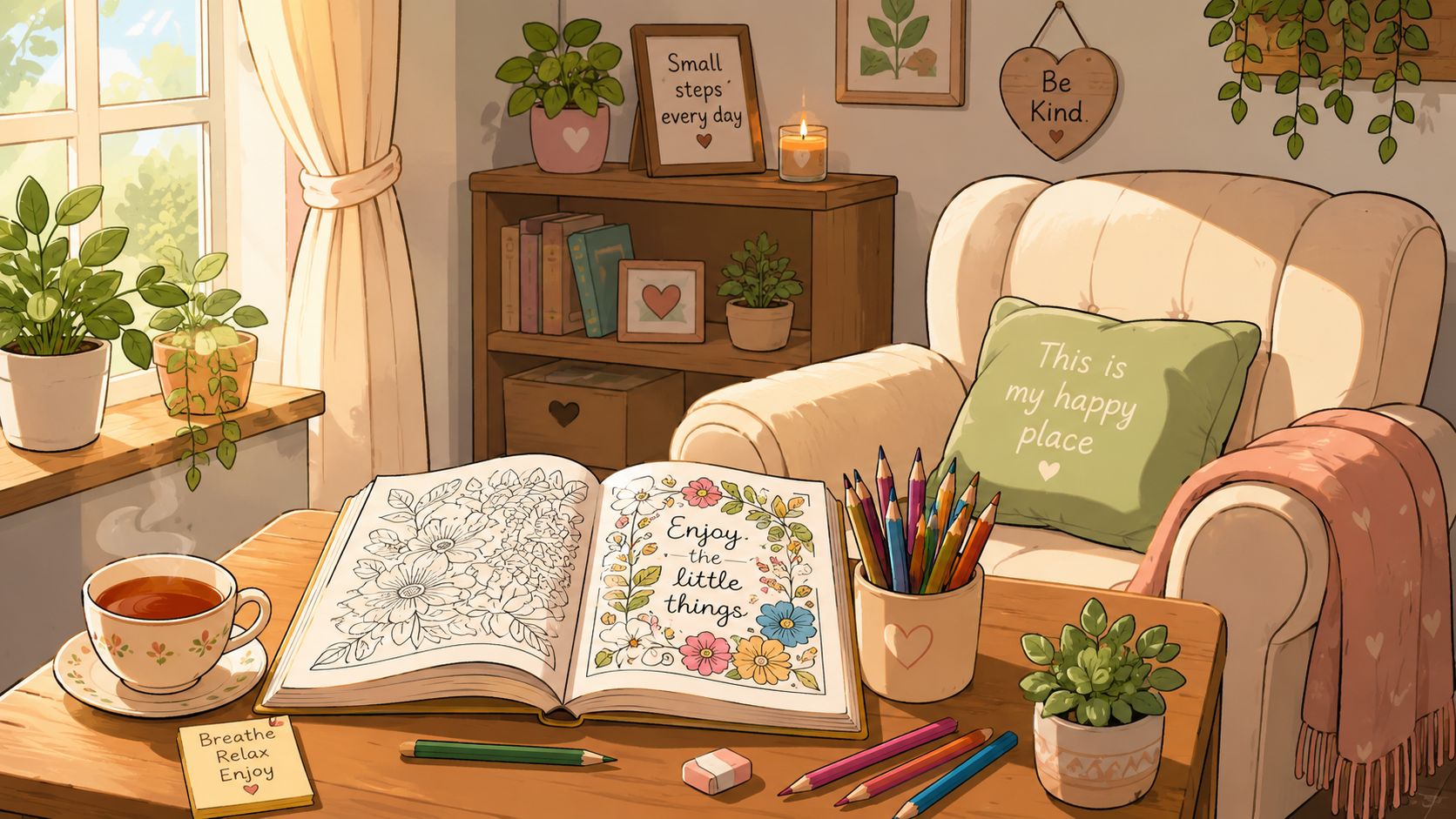
Your coloring area doesn't need to be a perfect craft studio. Mine is often just one corner of a table with a book, a pencil case, scrap paper behind the page, and a small lamp. The best setup is the one you'll use when you're tired.
A helpful sanctuary usually has three qualities. It feels reachable, it feels quiet, and it asks very little from you. If you have to unpack bins, compare every marker set, and clear a whole desk first, your nervous system is already doing work.
Try this simple reset ritual:
- Choose one spot: A couch tray, kitchen table corner, or bedside desk works.
- Leave out one book: Too many books can create the same overwhelm as too many markers.
- Add one comfort cue: Tea, soft socks, ambient music, or silence. Keep it personal.
- Protect the page if you use alcohol markers: A scrap sheet behind the paper keeps the experience smoother and less fussy.
If you're deciding between marker brands or trying to keep your setup simple, a marker comparison tool for common artist brands can help you narrow your choices before you sit down.
Cut decisions before they start
The biggest source of tension often arrives before coloring even begins. It's the open case full of options.
A review in the Journal of the International Society of Sports Nutrition noted a key pitfall: selecting more than 10 tools before starting increases pre-task anxiety and reduces flow-state entry by approximately 40%, and it recommends limiting your selection to 5 to 7 markers or pencils to prevent decision fatigue, as summarized in this coloring and mindfulness review%201-21%20Coloring%20and%20Mindfulness.pdf).
That matches what many colorists feel in real life. Too many choices can make your brain rev up instead of settle down.
Here's the palette ritual I return to:
| Moment | What I choose |
|---|---|
| First color | One soft main color, often blue, sage, or peach |
| Support colors | Two nearby shades that won't clash |
| Grounding tones | One neutral and one deeper shade |
| Optional accent | One brighter marker only if the page asks for it |
Practical rule: Put the rest of the case away. If you can see every possible color, your brain may keep shopping instead of resting.
This part matters because preparation is not separate from relaxation. Preparation is the first layer of it.
Choosing Pages and Palettes That Soothe
Why complicated pages can backfire
Many adults assume the most intricate page will be the most therapeutic. It looks artistic, serious, and immersive. But stress relief coloring often works better when the page is simpler than your ego wants and kinder than your perfectionism expects.
That's the heart of the Color-Pressure Paradox. A page can look relaxing and still create pressure. Tiny spaces, dense detail, and bleed-sensitive marker work can push beginners into self-monitoring mode. Instead of noticing color and motion, they start worrying about mistakes.
A recent discussion of adult coloring as self-care highlights this clearly: the therapeutic benefit is strongest when people adopt a “regulation over results” mindset, and high-complexity pages can increase anxiety for novice colorists by triggering performance pressure, as described in this adult coloring self-care best practices article.
If you use Ohuhu, Copic, or Prismacolor markers, you may know this feeling already. Alcohol markers are smooth and satisfying, but they can also make tiny spaces feel unforgiving. A beginner with a hyper-detailed page often ends up gripping the marker too tightly and second-guessing every choice.
A calmer page usually has:
- Bigger color zones: Broad leaves, roomy petals, simple rooms, chunky mushrooms, stars, or repeating waves
- Clear outlines: You can see where to go next without scanning the whole page
- Natural stopping points: One flower, one window, one cluster of shapes
- Visual breathing room: Some white space is good. Not every inch needs activity
If a page makes you feel behind before you begin, it's probably the wrong page for stress relief tonight.
A simple way to choose a calming palette
Once the page is gentle, your colors can stay gentle too. You don't need color theory homework to make a soothing palette.
I like to think in moods:
- Cool and settled: Blue, blue-green, sage, eucalyptus, gray
- Soft and cozy: Blush, dusty rose, cream, warm beige, muted coral
- Fresh but quiet: Olive, moss, pale yellow, muted aqua
- Nighttime calm: Indigo, plum, smoky teal, soft brown
Instead of asking, “What colors would look impressive?” ask, “What colors feel easy to sit with for twenty minutes?”
A small trick helps. Pick one anchor shade, then add neighbors. If your anchor is sage green, choose a lighter green, a muted blue, a warm neutral, and one deep olive or brown for contrast. This keeps the page cohesive without making you plan every inch.
For people who freeze at palette planning, a marker-friendly palette generator for coloring ideas can take some of the guesswork out before you touch the page. That can be especially helpful when your goal is calm, not experimentation.
Mindful Techniques for Your Coloring Session
You sit down hoping to relax, then your mind starts grading the page. Am I choosing the right color? Should I blend this better? Did I pick something too detailed again?
That reaction is common, especially if the page already asked a lot from you. This is the Color-Pressure Paradox in real life. Coloring can calm you, but only if the session feels manageable once you begin. The goal here is simple. Give your attention one small, steady place to rest.
I use a short timer for that reason. As noted earlier, even a brief session can help your body settle. A timer works like a soft edge around the activity. It keeps coloring from turning into an open-ended project and helps you stay with one gentle pocket of the page.
Start small enough that your brain can follow
Before you make the first mark, pause and let your shoulders drop. Then pick one contained area. A leaf cluster, one window, a single flower, one corner of a mandala.
Small sections are helpful because they reduce decision traffic. Your brain is no longer trying to manage the whole page at once. It only has to answer one easy question. Where will this color go next?
If you tend to freeze once the book is open, previewing a few page styles in a coloring theme preview tool can make it easier to choose a section that feels calm instead of crowded.
Let the page give you your focus points
Mindful coloring is less about clearing your mind and more about returning your attention kindly. I treat the page like a set of quiet anchors:
- the sound of pencil or marker on paper
- the pressure in your fingertips
- the edge of a shape filling in
- the tiny decision of the next stroke
When your mind drifts to tomorrow, gently come back to one of those. No correcting tone. No inner lecture. You are practicing returning, not performing.
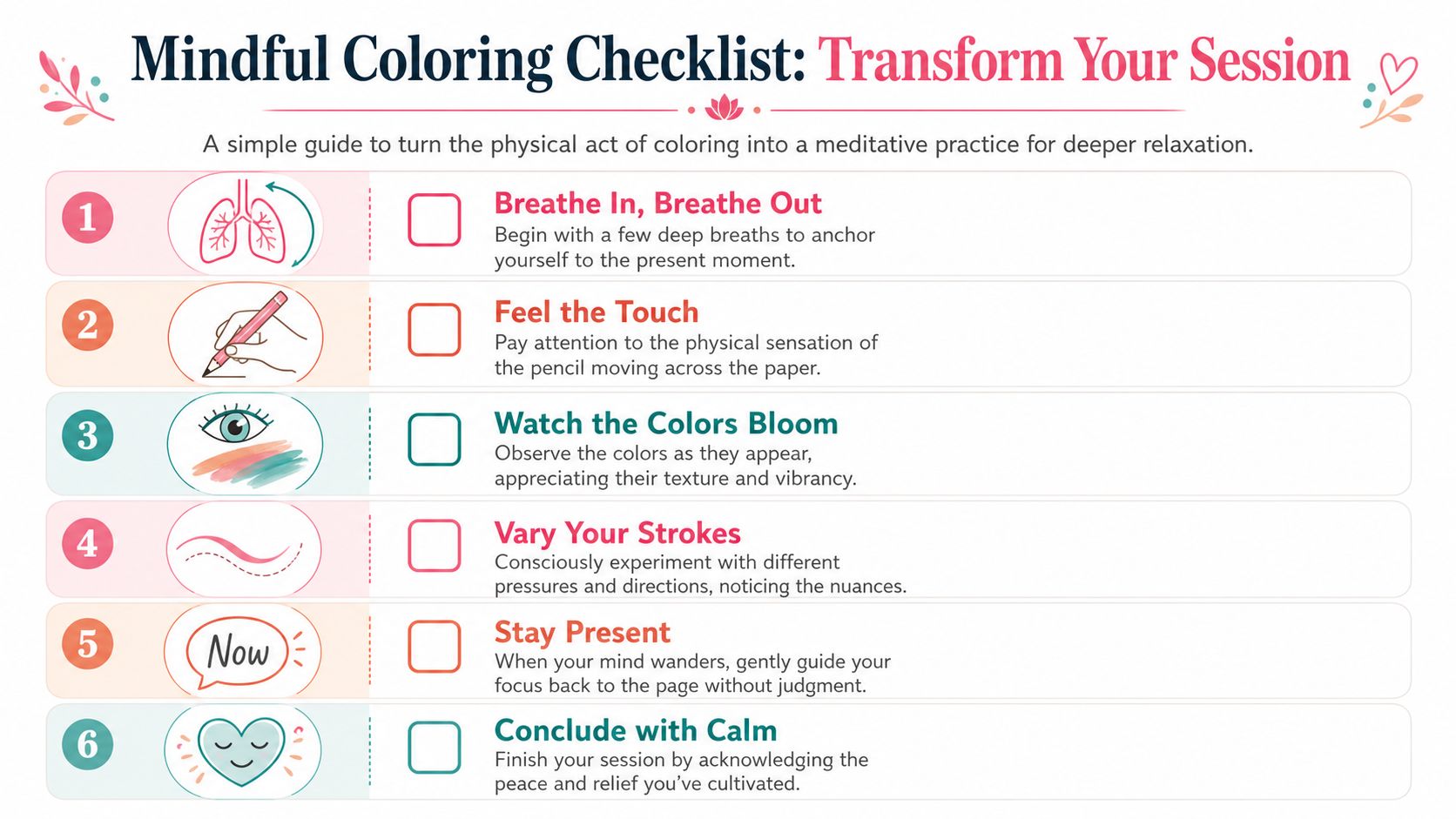
Six ways to make coloring feel meditative
Match breath to motion
Inhale while choosing the next shape. Exhale while filling it. The rhythm does not need to be exact. A loose pairing is enough to slow the pace.Notice how your tool behaves
Colored pencils ask for layering. Markers ask for smoother commitment. Paying attention to that feel keeps you in the present moment.Watch the color arrive
Follow the pigment as it spreads across the paper. It gives your eyes one quiet job.
A lot of the calm comes from giving your brain one concrete, non-urgent thing to notice.
Relax your grip
A tight hand often brings tight shoulders with it. Soften your fingers, unclench your jaw, and lighten the stroke.Use reassuring self-talk
If you slip outside a line, try “still okay” or “good enough for tonight.” That small shift matters. Stress relief coloring works best when the page does not become another place to judge yourself.Stop while you still feel settled
You do not need to finish the page to get the benefit. In fact, stopping with a little energy left often makes it easier to come back tomorrow.
If you like seeing a calm routine in action, this short video fits nicely before a session:
Building a Consistent Coloring Habit for Lasting Relief
Think in rhythms, not big goals
One relaxing session is lovely. A repeatable session is where coloring starts to feel like support.
For people under sustained stress, consistency seems to matter. In a study of nurses in high-stress jobs, the strongest stress reduction appeared when participants accumulated 100 minutes of total coloring time over a 10-day period, such as 20 minutes for 5 days, as reported in this mindful coloring study in nurses.
I like this finding because it takes pressure off the idea of one perfect session. Relief can come from returning to coloring regularly, even if each session is modest.
A few routines work especially well:
- After-work landing: Sit down with your drink, color before opening social apps
- Evening transition: Color after dinner as a cue that the productive part of the day is over
- Weekend reset: Keep one easy page for Saturday morning when you want your brain to wake up gently
Track gently, not rigidly
Rigid habit tracking can turn a calming hobby into homework. A softer way is to keep tiny signs of continuity.
You might mark a dot on a calendar, keep one bookmark in your current coloring book, or choose a theme in advance for the next session. If you enjoy planning visually, a theme preview tool for testing coloring moods can help you decide what kind of page and atmosphere you want before you begin.
A low-pressure habit usually has these features:
| Helpful habit cue | Why it works |
|---|---|
| Same time of day | Your brain starts to expect the wind-down |
| Same small kit | Fewer setup decisions |
| One page chosen ahead | Less friction when energy is low |
| Permission to stop early | Keeps the habit kind and sustainable |
A lasting coloring habit doesn't depend on motivation. It depends on making the next session feel easy to start.
If you miss a day, nothing is broken. Just return to the page.
Your Path to a More Colorful and Calmer You
Some evenings, the best win is reaching for a page instead of staying stuck in the day's noise. That small choice counts.
Over time, you'll start to notice your own calm signals. Maybe broad shapes settle you faster than tiny details. Maybe two or three familiar colors feel better than deciding among dozens. The key skill is learning your nervous system's preferences.
The Color-Pressure Paradox reveals that a page that looks beautiful in theory can feel crowded and demanding in practice, especially when your brain is already tired. The most soothing coloring routine is the one that meets you at your current energy level, not the one that asks you to rise to it.
So let your coloring practice stay personal, gentle, and a little imperfect. If you finish a page, lovely. If you color one leaf and feel your shoulders drop, that counts too.
If you'd like a cozy helper for palette planning, marker-friendly previews, and low-pressure color exploration, try ColorBestie. It's a simple way to test moods, palettes, and marker-inspired looks before you commit ink to paper, especially if you use Ohuhu, Copic, Prismacolor, or similar alcohol markers.