You're probably here because you've looked at a few coloured pencil sets and hit the same wall commonly faced. One tin says “professional,” another says “soft core,” another promises vivid colour, and then there's a price jump that makes you wonder whether you're buying art supplies or jewellery.
That confusion makes sense. One public test video claims to have evaluated 4,000+ coloured pencils from 90+ brands, which shows just how crowded and fragmented this category has become (large-scale coloured pencil test video). So instead of treating this like a hunt for one magical winner, it helps to build a decision framework first.
That's the answer to the question, what are the best coloured pencils. The best ones are the pencils that match your hand, your paper, your subjects, and your budget. If you enjoy relaxed blending in colouring books, you'll want something different from an illustrator who needs crisp fur texture or botanical detail. And if you plan colours digitally before you draw, tools like ColorBestie can help you test palette direction before you commit to a full traditional workflow.
Your Guide to Navigating the World of Coloured Pencils
You walk into an art shop planning to buy one sensible set. Ten minutes later, you're holding three boxes and reading words like “lightfast,” “oil-based,” and “artist quality” as if there will be a quiz at the till.
That experience is normal. The coloured pencil market is so broad that many buyer guides no longer try to crown one universal winner. They sort pencils by use case instead. That shift makes sense when the field includes beginner sets, hobby sets, and professional ranges with very different handling.
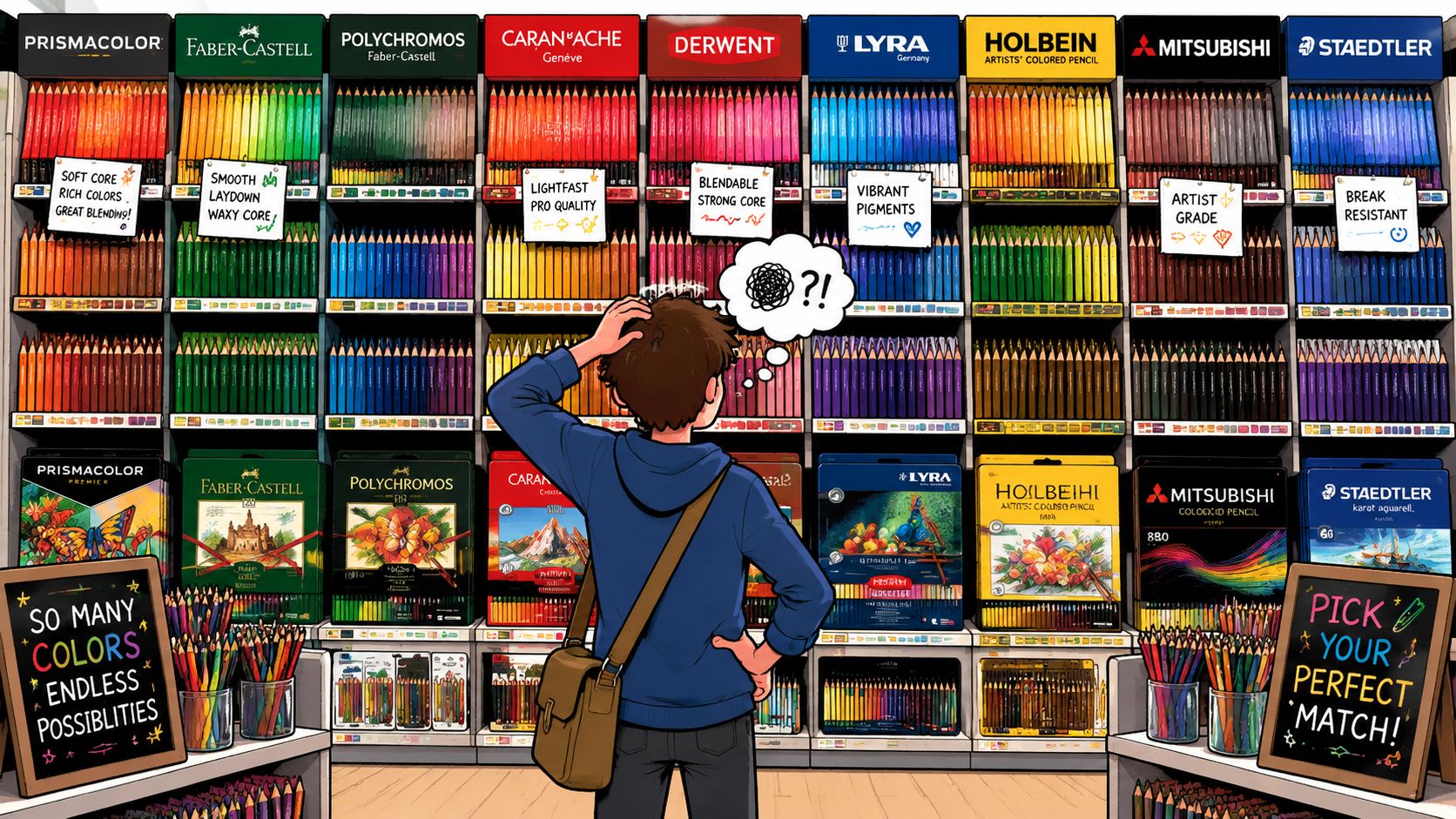
Here's the part that offers some relief. You do not need to know every brand before you buy well. You only need to answer a few practical questions:
- What do you draw most often: colouring books, portraits, flowers, nature scenes, sketchbook pages, or polished final art?
- What frustrates you most: scratchy laydown, broken tips, muddy layers, or colours that won't blend?
- How do you like to work: soft and painterly, or sharp and controlled?
- How permanent does the result need to be: casual enjoyment, gifts, commissions, or display work?
The smartest pencil choice usually starts with your drawing habits, not the brand name on the tin.
Once you see pencils as tools with different personalities, the shelf gets much less intimidating. Some pencils are made to glide and smudge into velvety colour. Others are built to hold a point and behave neatly in tiny spaces. Some are ideal for relaxed hobby use. Others earn their higher cost by offering more consistent performance for finished artwork.
That's why this guide starts with decisions first and brands second.
Understanding the Core Wax vs Oil Pencils
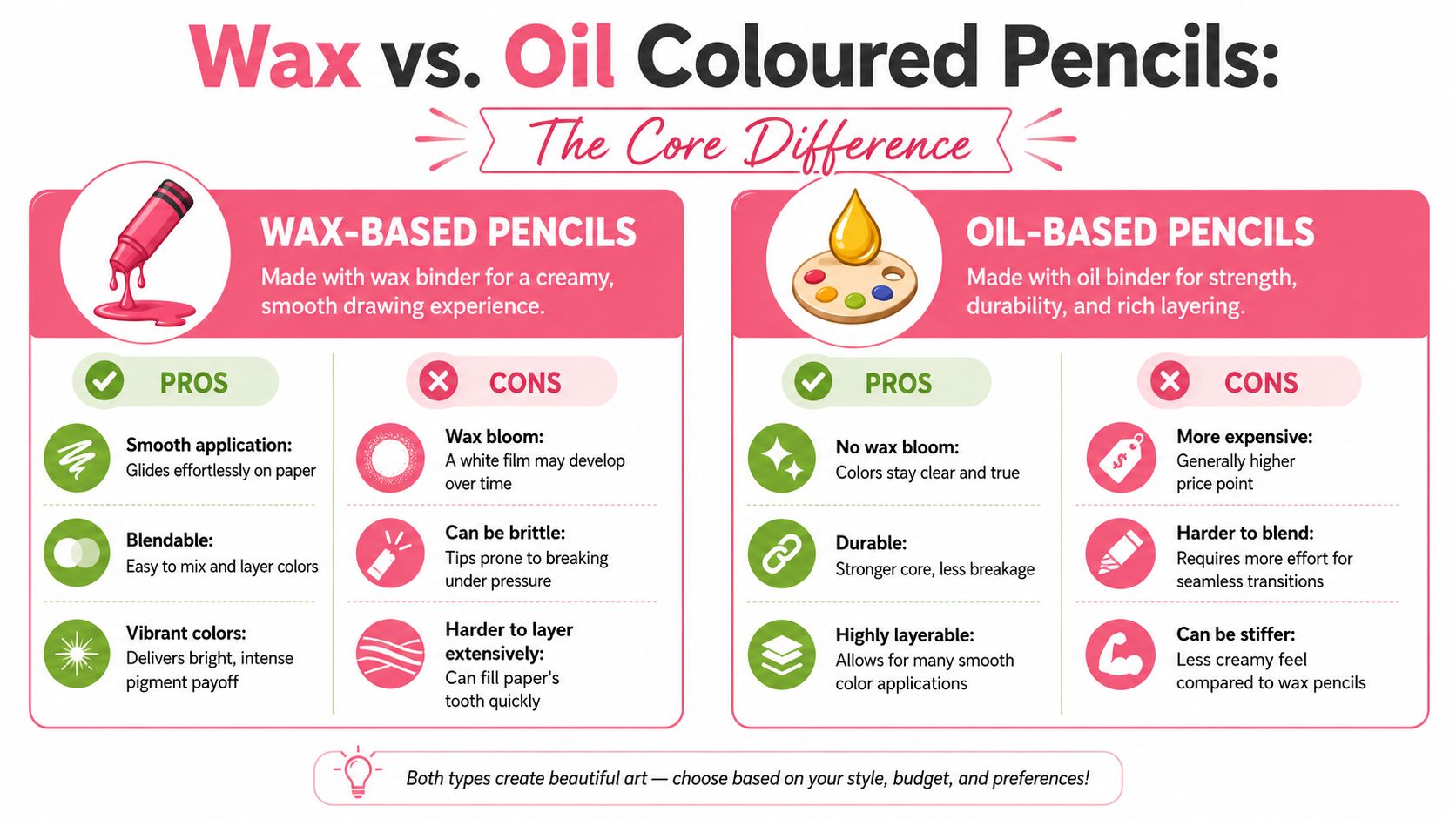
If coloured pencils feel mysterious, this is the key that clarifies most of it. At the centre of the decision is the binder. In plain terms, pigment is held together in the pencil core by a formula that is usually described as wax-based or oil-based.
A simple way to remember the difference is this. Wax-based pencils feel more like soft butter. Oil-based pencils feel more like firm margarine. Butter spreads quickly and smoothly. Margarine keeps its shape a bit more. That's not a chemistry lesson. It's a handling lesson.
Why wax-based pencils feel easier to blend
Softer wax-based pencils are often the first ones people fall in love with. They tend to lay down colour quickly, feel creamy on the page, and make blending less of a battle. Guides that compare coloured pencils often recommend Prismacolor Premier for blending and saturation because the soft core deposits rich pigment and burnishes faster (comparison of blending-focused coloured pencils).
That makes them appealing for:
- Adult colouring books where you want smooth, even coverage
- Bold florals and portraits where rich colour matters
- Layering without lots of pressure when your hand gets tired easily
The tradeoff is part of the package. Softer pencils wear down faster, can feel more delicate, and in heavy applications may develop wax bloom, which is a pale film that can appear on dense layers.
Why oil-based pencils suit precision
Oil-based pencils usually feel firmer and more controlled. They don't rush colour onto the page in the same creamy way, but they reward patience. They tend to hold a sharp point longer, which helps with eyelashes, fur, leaves, lettering, and edges where sloppy marks stand out.
JetPens identifies Faber-Castell Polychromos as an oil-based artist pencil with richly pigmented cores, and that oil-based character is one reason artists often choose it for detail and edge control (JetPens coloured pencil guide)).
Practical rule: If you want soft gradients fast, start by looking at wax-based pencils. If you want cleaner details and a point that lasts, start with oil-based pencils.
A lot of beginners think one type must be “better.” It isn't that simple. Wax-based pencils often feel friendlier at first. Oil-based pencils often feel more precise. Your best choice depends on whether you want coverage or control.
Whats the Difference Between Student and Artist Grade Pencils
This label confuses people because it sounds like pure marketing. Sometimes it is. But there are still useful differences behind it.
Student grade pencils are usually designed to be affordable, approachable, and forgiving for casual practice. Artist grade pencils are aimed at people who care more about performance consistency, richer colour, and lasting finished work. The price difference often reflects those priorities.
What artist grade usually buys you
Three things matter most.
Pigment concentration
Artist-grade pencils usually feel stronger in colour with less pressure. You don't have to grind the pencil into the paper to get a satisfying result.Lightfastness attention
For finished artwork, fading matters. Artist-grade ranges are more likely to be discussed in terms of lightfastness standards such as ASTM or Blue Wool. That matters if your work will be displayed, sold, or kept for years.Build quality
Better wood casing, more consistent cores, and more reliable sharpening can make drawing feel calmer and less wasteful.
A technical point often missed by beginners is that “artist grade” doesn't just mean “nicer.” It means the pencil is built for more demanding expectations. If your goal is a colouring session on the sofa, you may not need that. If your goal is a finished portrait for framing, you probably do.
When student grade makes perfect sense
Not every drawing needs museum-level permanence. Plenty of hobbyists are happier with a good student set because it lets them explore colour without worrying about every pencil stroke feeling expensive.
Student grade is a sensible choice when you:
- Practice often and go through pencils quickly
- Colour for relaxation rather than display
- Want a broad set before investing in open-stock artist pencils
- Prefer experimenting over preserving finished pieces
Buy for the life of the artwork. A colouring book page and a commissioned portrait don't need the same level of material performance.
One thing helps many artists make peace with the cost question. You don't have to choose one camp forever. Many people begin with a student set, then add a handful of artist-grade pencils in the colours they use most. That hybrid approach often gives you the best value.
How to Test Coloured Pencils Like an Artist
You are in an art shop, staring at two sets that look equally tempting. One has glowing reviews. The other feels better in your hand. A quick test sheet helps you choose with more confidence than any top-10 list.
That matters because coloured pencils are tools with personalities. A waxier pencil often glides on like soft butter. An oilier pencil usually feels firmer, more like margarine straight from the fridge. Neither is automatically better. The useful question is simpler: does this pencil behave the way you want it to behave?
A pencil can be highly praised, but it might still feel wrong for you.
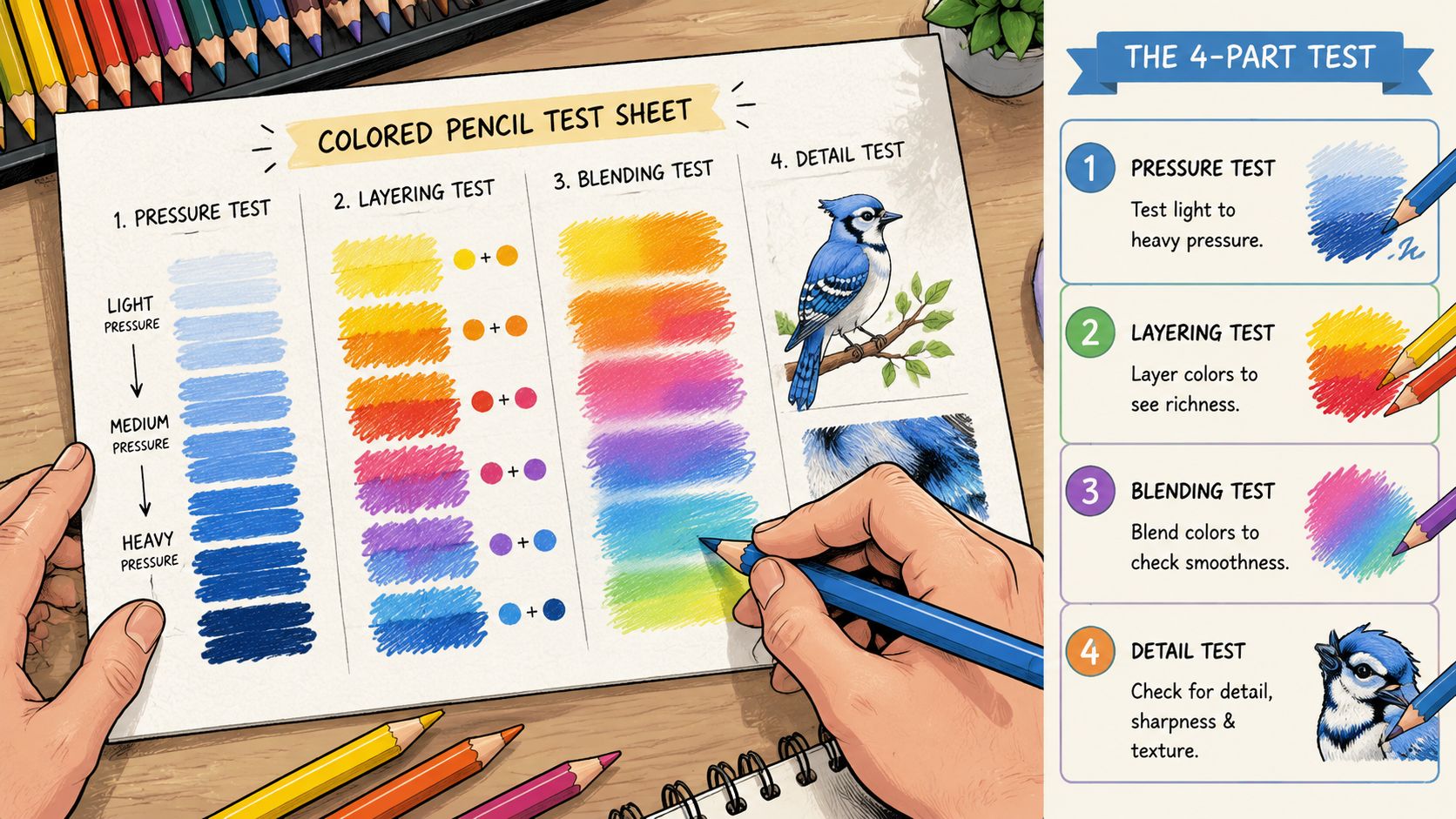
The easiest way to find out is to make a small test sheet before buying a full set, or before starting a piece you care about. Use the same paper for every pencil so the comparison stays fair. If you switch paper halfway through, you may be judging the surface instead of the pencil.
Start with four simple tests
Layering
Put down one light layer, then add a second and third in the same area. Notice how long the pencil keeps accepting colour before the paper fills up. Softer, wax-heavy pencils often give quick colour early on. Firmer pencils often leave more room for controlled layers.Blending
Make a gradient from dark to light. Then overlap two neighbouring colours, such as blue into green. Look for a smooth transition instead of obvious stripes. If you enjoy soft, painterly colour, this test tells you a lot very quickly.Burnishing
Choose a small patch and press harder until the tooth of the paper starts to flatten. You are checking whether the pencil can create that polished, saturated finish some colourists love. If you prefer bold florals, colouring books, or rich backgrounds, this test matters.Point strength
Sharpen the pencil and draw tiny lines, eyelashes, fur marks, or other repeated details. Watch what happens to the tip. A pencil that stays sharp longer usually feels easier to control for crisp edges and fine work.
If you want to plan colour combinations before testing them on paper, the ColorBestie palette generator is a useful way to sketch out a few harmonious options first.
What to notice while you test
A good test sheet shows friction, control, and effort. You are not trying to make pretty swatches. You are checking how hard the pencil makes you work.
Ask yourself:
- Does the colour appear easily, or do I need to press hard?
- Can I get both soft shading and clean detail?
- Do layered colours stay clear, or do they turn muddy fast?
- Does the pencil suit the subjects I draw?
That last question is where many hobbyists get stuck. A pencil that feels wonderful for soft flowers may frustrate you in architecture or detailed animal fur. A firmer pencil that seems less exciting in a quick swatch may become your favourite for careful layering.
If a pencil irritates you in five minutes, it will probably irritate you in five hours.
Seeing the motion can help too, especially with pressure control and blending speed.
Keep every test sheet. Label the brand, paper, and sharpener. After a few sessions, you will start building your own decision framework. You will know whether you like soft or firm cores, whether you value blending or detail more, and which pencils are worth your money.
Best Coloured Pencils by Use Case and Budget
By this point, you already know the two questions that matter most. Do you prefer a softer wax feel or a firmer oil feel? And are you buying for practice, finished artwork, or a bit of both?
Those two choices narrow the field faster than any “best pencils” list.
2026 Coloured Pencil Recommendations
| Pencil Name | Core Type | Best For | Price Range |
|---|---|---|---|
| Prismacolor Premier | Wax-based | Rich blending, burnishing, saturated colour | Mid to premium |
| Faber-Castell Polychromos | Oil-based | Fine detail, edge control, crisp layering | Premium |
| Caran d'Ache Luminance | Soft artist pencil | Lightfast-focused finished artwork | Premium |
| Student-grade house or school sets | Varies | Practice, casual colouring, broad experimentation | Budget |
For rich blending and saturation
If you want colour to appear quickly and blend with very little struggle, Prismacolor Premier is still one of the clearest picks. It suits the artist who wants a generous, creamy laydown and enjoys building soft transitions without pressing hard.
Butter is a useful comparison here. A waxier, softer pencil spreads colour the way soft butter spreads on warm toast. It feels immediate and satisfying. The tradeoff is that it can flatten its point sooner and ask for gentler sharpening.
Prismacolor usually suits hobby artists who say:
- I want bold colour fast
- I enjoy portraits, florals, and colouring pages
- I care more about smooth blends than razor-sharp detail
If your drawings are expressive and layered in broad passages, this type of pencil often feels encouraging from the first page.
For crisp details and controlled layering
Faber-Castell Polychromos fits a different hand. If Prismacolor feels soft and painterly, Polychromos feels more measured. Its firmer oil-based core usually holds a point longer, which makes it easier to place hair, feather edges, leaf veins, and other small shapes that need control.
Margarine is a simple comparison. It still spreads, but it has a slightly firmer structure. That firmer feel helps many artists stay accurate, especially when they like to build colour slowly instead of filling the page quickly.
Polychromos makes sense if you often think:
- I want cleaner edges
- I layer patiently
- I get annoyed when a soft pencil feels mushy
Some hobbyists draw better with a pencil that resists them a little. A firmer core can steady your hand and slow you down in a good way.
For archival priorities and serious finished work
Caran d'Ache Luminance enters the conversation when the drawing itself matters as much as the drawing experience. If you are making work to frame, gift, sell, or keep for years, lightfastness starts carrying more weight.
This is a good reminder that “best” changes with the job. A pencil can feel beautiful in the hand and still not be your first choice for work you want to preserve carefully. Luminance is often chosen by artists who want strong handling and more confidence in how the colour will hold up over time.
This type of pencil is a sensible fit for:
- Display pieces
- Portfolio work
- Finished art with long-term value
The softest pencil is not automatically the smartest buy. Sometimes the better pencil is the one that supports the life of the artwork.
For a budget-friendly start
Budget sets have a real purpose. They let you learn what kind of pencil hand you have before you spend premium money on features you may not use.
That matters more than beginners expect.
A student-grade set works well if you are coming back to drawing after a break, buying for a younger artist, or using coloured pencils as a supporting medium rather than your main one. If you also use markers, the ColorBestie marker comparison tool for comparing marker brands and features can help you decide how pencils will fit into your wider setup.
A smart budget plan is simple. Start with a smaller set, notice which colours disappear first, then replace or upgrade selectively through open stock if the brand offers it. That approach gives you a personal system, not just a shopping list.
Pencil Care and Creative Mixing Techniques
Good pencils can feel bad if they're badly sharpened, dropped, or used in the wrong order with other media. A few basic habits solve most of the common complaints people have.
Sharpening without heartbreak
Lead breakage often has less to do with the pencil and more to do with pressure, sharpener quality, or hidden core damage from being knocked around.
Try these habits:
Use a sharp, clean sharpener
A dull blade chews the wood and stresses the core.Turn the sharpener or turn the pencil gently
Don't force it. Slow rotation usually gives a cleaner point.Match the point to the job
Needle-sharp points are great for detail, but a slightly blunter point is safer for soft cores and broad shading.Store pencils where they won't rattle
Tins, wraps, and trays all work if they stop the pencils banging into each other.
Helical sharpeners can feel steadier for frequent use, while a good manual sharpener gives more control. The better option is the one that matches your pencil softness and your own hand.
Mixing coloured pencils with markers
This is one of the most useful combinations for hobby artists. Markers can establish fast base colour. Coloured pencils can then add texture, edges, shadows, and tiny accents that markers can't place as neatly.
The safest order is usually:
- Markers first
- Let them dry
- Add coloured pencil on top
That order matters because pencils over marker are usually fine, but scribbling alcohol marker over a waxy pencil layer can dirty or stress the nib.
A few smart pairings:
- Use marker for base skin tone, then pencil for blush, eyelashes, and lip texture
- Use marker for large foliage shapes, then pencil for veins, shadows, and edge cleanup
- Use marker for sky or background, then pencil for foreground details
You can also try solvent blending with coloured pencil, but test first. Different pencils react differently, and some papers buckle or lose tooth faster than you expect.
Markers handle speed well. Pencils handle nuance well. Together, they cover each other's weak spots.
Frequently Asked Questions About Coloured Pencils
What paper works best for coloured pencils
Look for paper with enough tooth to grab pigment. If the paper is too slick, layers slide around instead of building. If it's extremely rough, smooth blending becomes harder. For colouring books, the paper is chosen for you, so adapt your pressure to the surface. For standalone art, test a few papers and keep notes.
Can I mix brands in one drawing
Yes, and many artists do. A common mix is to use a softer pencil for broad blending and a firmer pencil for final details. The only caution is to pay attention to order. If one pencil leaves a very slick surface, later layers may not grip as well.
Why do my pencil points keep breaking
Usually one of four reasons is responsible:
- You're pressing too hard
- The sharpener blade is dull
- The pencil has internal damage from dropping
- You're trying to get too long a point for a soft core
Shorter, sturdier points often solve the problem immediately.
What is wax bloom
Wax bloom is the pale, cloudy film that can appear on heavy applications of wax-based coloured pencil. It tends to show up when layers get dense and polished. You can usually wipe it away gently, then adjust your layering approach if it keeps appearing.
Are expensive pencils always better
No. They're often better for a specific purpose. Artist-grade pencils can offer richer pigment, better handling, and stronger lightfastness discussions, but that doesn't mean every hobbyist needs them. If you colour for relaxation, a pleasant and affordable set may serve you better than a premium range that makes you nervous to use.
If I only buy one good set, what should I choose
Choose based on your drawing style. If you love creamy blending and saturated colour, start with a soft wax-based option such as Prismacolor Premier. If you value precise details and a firmer point, start with an oil-based option such as Polychromos. If permanence is the priority, look harder at artist lines known for lightfastness-focused discussion.
If you want help choosing colours before you commit them to paper, ColorBestie offers a simple way to preview marker-style palettes, compare colour directions, and plan combinations that can then guide your coloured pencil choices too.